
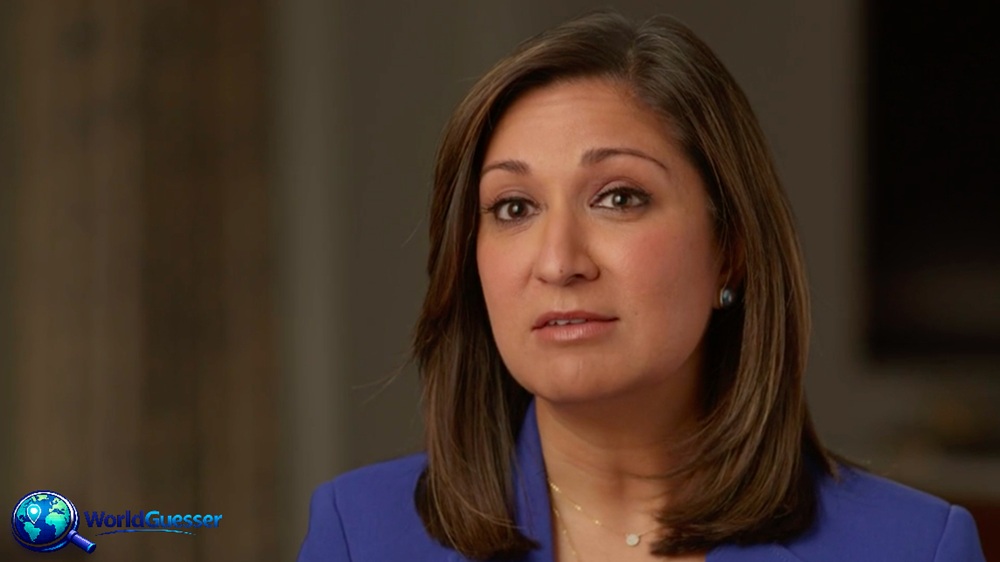
Amna Nawaz is, by any serious measure, one of the most consequential broadcast journalists working in American public media today. She co-anchors the PBS NewsHour alongside Geoff Bennett — the programme that has served as the gold standard of American television journalism for over five decades, the broadcast that serious people in serious professions watch when they need to understand what is actually happening in the world rather than what the cable news cycle has decided is happening. She has covered wars in Afghanistan and Pakistan from the ground. She was the first journalist — the very first, in the entire history of American presidential debates — to moderate one of those debates as an Asian American and as a Muslim American. She has won both an Emmy and a Peabody Award. She speaks four languages. She built an entirely new digital journalism platform from scratch during her NBC years. And she did all of this while raising two daughters with a husband who voluntarily left his own significant career at the New York Times to become the family’s primary caregiver — a decision that says as much about who the Nawaz-Werdel household actually is as any award or historic milestone.
| Quick Facts | Details |
|---|---|
| Full Name | Amna Nawaz |
| Date of Birth | September 18, 1979 |
| Age (2026) | 46 years old |
| Birthplace | Virginia, USA |
| Father | Shuja Nawaz — former Pakistan Television journalist (1967–1972), later author and defense analyst; brother of Gen. Asif Nawaz Janjua (former Pakistani Army Chief of Staff) |
| Mother | Seema Nawaz |
| Nationality | American (first-generation; Pakistani heritage) |
| Languages | English, French, Urdu, Hindi |
| High School | Thomas Jefferson High School for Science and Technology, Fairfax County, Virginia |
| University | University of Pennsylvania — B.A., Politics, Philosophy & Economics (2001); co-captained varsity field hockey |
| Graduate Degree | London School of Economics — M.A., Comparative Politics |
| Additional Study | University of Zimbabwe (semester abroad) |
| Career Start | ABC News Nightline Fellow (2001) |
| NBC Role | Foreign correspondent; Islamabad Bureau Chief; founder, NBC Asian America platform (2014) |
| ABC Role | Anchor and correspondent; 2016 presidential election livestream lead |
| PBS Start | April 2018 — Correspondent and Chief Correspondent |
| Current Title | Co-Anchor and Co-Managing Editor — PBS NewsHour (since January 2023) |
| Historic First | First Asian American and first Muslim American to moderate a U.S. presidential debate (December 2019) |
| Awards | Emmy Award; Peabody Award (2019, The Plastic Problem series); Society for Features Journalism Award |
| Husband | Paul Werdel — former NYT Product Director; married 2007 |
| Children | Karam Werdel, Lina Werdel |
| Residence | Alexandria, Virginia |
| Net Worth (est. 2026) | $2 million – $3 million |
Amna Nawaz’s net worth is estimated at between $2 million and $3 million — a figure that reflects the particular financial character of public broadcasting, which compensates its best people well but not extravagantly, and which produces careers built on credibility and longevity rather than the salary spikes that commercial network anchors occasionally receive. The number is real, the career behind it is genuinely exceptional, and the story of how a first-generation American daughter of Pakistani immigrants arrived at the co-anchor chair of the most respected evening news programme in the country is worth telling in full.
Virginia Roots, Pakistani Heritage: The Family That Shaped Everything
Amna Nawaz was born on September 18, 1979, in Virginia — making her a first-generation American in the most specific sense of that phrase. Her parents were Pakistani immigrants who brought with them to the United States not just the practical ambition of people building new lives in a new country, but the specific intellectual and civic culture of an educated Pakistani family with deep roots in journalism, public service, and national affairs.
Her father, Shuja Nawaz, was a journalist with Pakistan Television from 1967 to 1972 before eventually transitioning to a distinguished career as an author and defence analyst — writing extensively about the Pakistani military and American-Pakistani relations, becoming a recognised authority on South Asian security, and contributing to organisations including the Atlantic Council. His brother — Amna’s uncle — was General Asif Nawaz Janjua, who served as Chief of Staff of the Pakistani Army from 1991 until his death in 1993. The family background is, in short, one of extraordinary intellectual and institutional distinction. Journalism, analysis, public accountability — these were not abstract professional categories in the Nawaz household. They were the substance of what the adults around a young Amna Nawaz actually did.
Her mother, Seema Nawaz, provided the domestic foundation that made the family’s American life coherent and stable. Amna grew up as a first-generation American navigating the particular dual identity that children of immigrants from professional backgrounds inhabit: fluent in the culture around them, rooted in the culture behind them, and capable — when that navigation is done well — of seeing both with the clarity that genuine bilingualism, cultural as much as linguistic, provides.
She is fluent in four languages: English, French, Urdu, and Hindi. That quadrilingualism is not incidental. It is a direct expression of the multicultural formation her upbringing provided and the professional investment she made in expanding her communicative range as her international reporting career developed.
Thomas Jefferson High School: The Academic Foundation
Amna Nawaz attended Thomas Jefferson High School for Science and Technology in Fairfax County, Virginia — consistently ranked among the top public high schools in the United States, a magnet school whose admission is competitive and whose academic environment is characterised by the kind of intellectual intensity that produces research scientists, engineers, and policy professionals in disproportionate numbers.
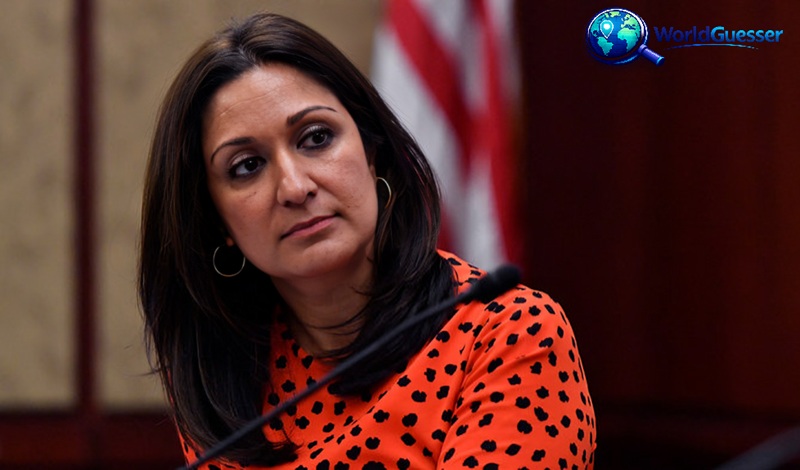
Thomas Jefferson is not, by design, a school for future journalists. It is a school for people who think rigorously, who pursue questions past their obvious surfaces, and who are comfortable with complexity. The analytical habits that define Nawaz’s journalism — the refusal to accept surface explanations, the insistence on context, the ability to ask follow-up questions that get at the actual substance of what a source is saying — were formed in exactly the kind of educational environment Thomas Jefferson represents.
She graduated and proceeded to one of the most academically selective universities in the country.
University of Pennsylvania: PPE and Field Hockey
At the University of Pennsylvania — one of the eight Ivy League institutions, and the one most closely associated with policy, practical public engagement, and the intersection of academic rigour with real-world application — Nawaz studied Politics, Philosophy, and Economics, graduating in 2001 with her bachelor’s degree.
The PPE combination is, internationally, the degree of choice for people who want to understand how power operates: philosophy provides the ethical framework, politics provides the institutional map, and economics provides the mechanism. It is the degree that produces prime ministers, senior civil servants, senior journalists, and the kind of policy analysts who actually understand what they are analysing. At Penn, Nawaz pursued it with the full seriousness the subject deserved.
She also co-captained the university’s varsity field hockey team — a commitment that speaks to a competitive and team-oriented dimension of her character that her journalism consistently reflects. Good anchors are, in their way, team players: they create environments in which colleagues, correspondents, and interviewees can perform at their best. The captaincy instinct is not unrelated.
After Penn, she pursued a Master’s degree in Comparative Politics at the London School of Economics — one of the world’s leading institutions for the study of political science and international relations, and a particularly appropriate environment for someone whose journalistic career would centre on the intersection of American domestic politics and international affairs. She also studied abroad at the University of Zimbabwe, a placement that gave her early direct exposure to Sub-Saharan African politics and society.
The Career Begins: Nightline Fellow and September 11
Nawaz began her journalism career as a Nightline Fellow at ABC News in 2001 — an entry-level fellowship programme that placed young journalists in a prestigious network environment and provided the foundational professional experience that academic preparation alone cannot supply. She wanted, at this stage, to pursue a career in law rather than journalism. That plan changed within weeks of her starting the fellowship.
On September 11, 2001, just weeks into her first professional position, the attacks on the World Trade Center and the Pentagon transformed the American news landscape overnight. Nawaz was, by the accident of timing, already inside a major American newsroom at the exact moment when that newsroom needed to cover one of the most significant events in modern American history. She was given the opportunity to contribute to the coverage. She discovered, in the process, that journalism — the real kind, the kind that matters — was where she wanted to be.
The 9/11 experience set the trajectory for everything that followed. It was not just that she was present for an important event. It was that the event revealed to her what journalism is actually for — what it means to bear witness to history and to help the public understand what is happening and why. That understanding, formed in the first weeks of her professional life, has never left her work.
NBC News: From Production Assistant to Islamabad Bureau Chief
At NBC News, Nawaz built her career from the production level upward with a consistency and purpose that reflects both her intellectual preparation and her personal discipline. She worked as a production assistant for all NBC News programmes and platforms — learning the craft from the inside out, understanding how the machinery of television journalism operates before positioning herself within it as a reporter and correspondent.
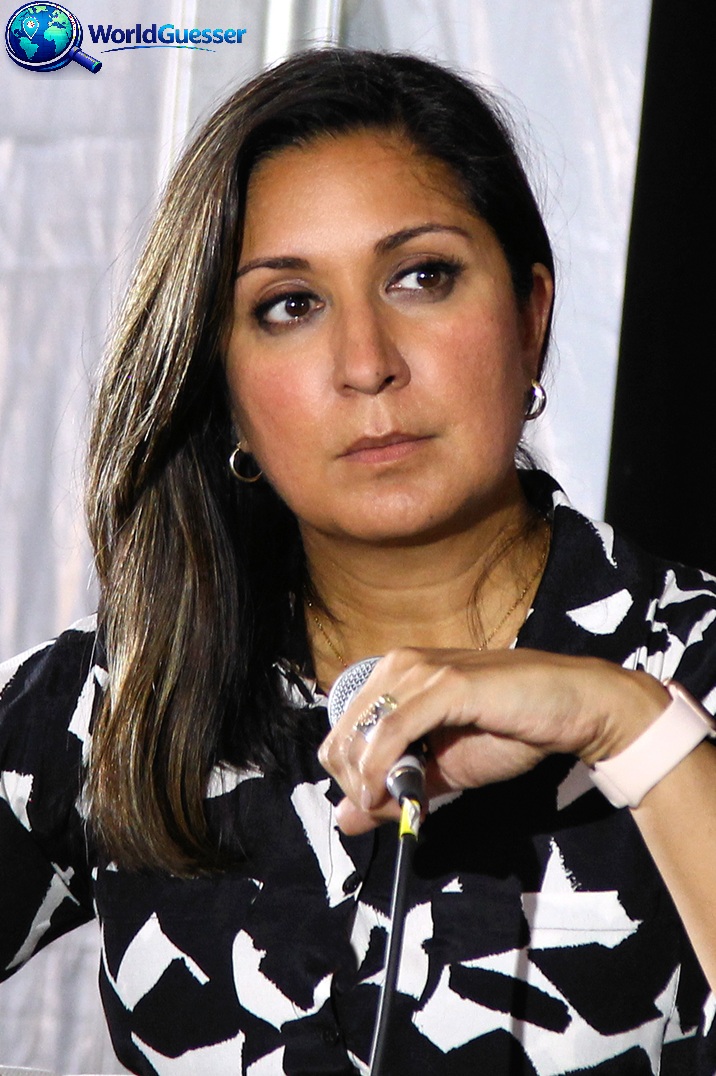
She rose through the NBC system to become its Islamabad Bureau Chief — the journalist responsible for NBC’s coverage of Pakistan, Afghanistan, and the surrounding region at a period of extraordinary geopolitical significance: the years of peak U.S.-Pakistan tension, the hunt for Osama bin Laden, the Taliban resurgence, the war in Afghanistan’s grinding middle chapters, and the complex domestic politics of a nuclear-armed state navigating its own deep internal contradictions.
Her Pakistan coverage demonstrated professional courage of a specific and verifiable kind. She was the first journalist — of any nationality, from any outlet — allowed inside North Waziristan, the tribal border region between Pakistan and Afghanistan that had become one of the primary operational bases for al-Qaeda and Taliban activity. Gaining access to North Waziristan required the kind of source cultivation, language ability, cultural fluency, and personal trust-building that take years to develop and that cannot be manufactured by any level of institutional credential. She was there. She reported from there. The stories she brought back informed American public understanding of a region that was shaping American foreign policy and American casualties in equal measure.
She also covered the Taliban’s attack on Malala Yousafzai in 2012 — one of the most internationally significant single events of that period — and reported on the attack and its aftermath with the depth and context that her years of Pakistan experience had uniquely positioned her to provide.
In 2014, she founded NBC’s Asian America platform — a digital vertical specifically designed to elevate journalism by and about Asian Americans, then the fastest-growing demographic in the United States and one of the most consistently undercovered by mainstream American media. She served as its founding managing editor, building the platform from the ground up, and it represented a commitment to the specific journalistic principle that good coverage requires diverse practitioners with genuine community knowledge — not just goodwill but actual expertise.
ABC News: The 2016 Election and the Uncomfortable Podcast
Nawaz joined ABC News as anchor and correspondent, serving from 2015 to 2018. At ABC, she anchored breaking news coverage and led the network’s digital coverage of the 2016 presidential election — one of the most consequential and chaotic electoral events in American history, a story that demanded simultaneous command of domestic politics, international implications, and the emerging role of digital platforms in shaping political reality.
She also hosted Uncomfortable — an ABC podcast that examined race, identity, and the unsettled questions of American pluralism. The podcast’s title reflected its editorial philosophy: that the conversations most needed are often the most avoided, and that journalism’s purpose includes creating space for those conversations rather than deferring to the comfort of silence.
PBS NewsHour: The Historic Presidency Debate and the Co-Anchor Chair
Nawaz joined PBS NewsHour in April 2018, initially as a correspondent and primary substitute anchor, and was promoted to Chief Correspondent in June 2021. In January 2023, she and Geoff Bennett took over as co-anchors and co-managing editors of the programme, replacing the legendary Judy Woodruff — one of the most significant leadership transitions in PBS NewsHour’s history.
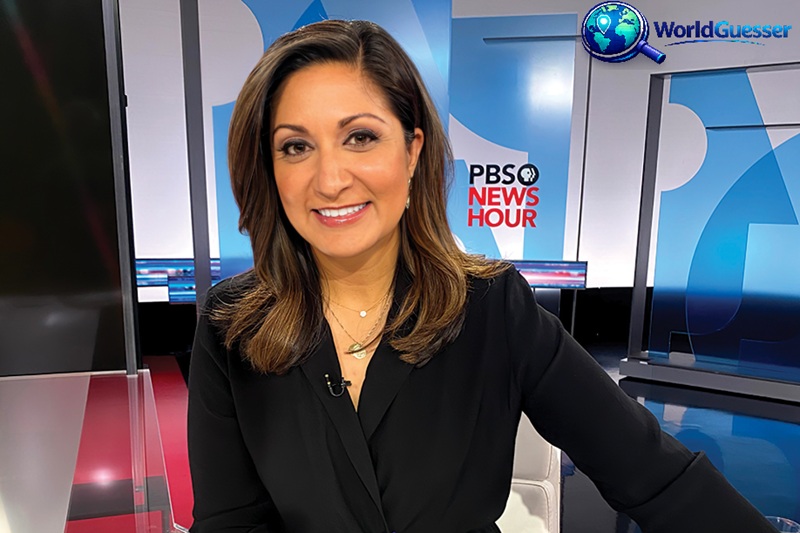
In December 2019, she co-moderated the PBS NewsHour/Politico Democratic Presidential Primary Debate — and in doing so became the first Asian American and the first Muslim American in history to moderate a United States presidential debate. The significance of that milestone extends beyond the personal. It is a measurement of how long it took American political journalism — one of the most powerful institutions in American public life — to include in its most formal ritual a person who represented two of the country’s largest and most historically underrepresented communities. That she was the first, in 2019, more than half a century after presidential debates became a fixture of American electoral culture, tells a complicated story about the industry she has spent her career inside.
Her reporting as part of the PBS NewsHour’s 2018 series The Plastic Problem was awarded a Peabody Award in 2019 — one of broadcast journalism’s most prestigious recognitions, given for excellence in electronic media. She also holds an Emmy Award for her contribution to the NBC News Special “Inside the Obama White House,” and a Society for Features Journalism Award.
| Amna Nawaz: Career Milestones | Year | Detail |
|---|---|---|
| ABC News Nightline Fellowship | 2001 | First professional role; 9/11 happened weeks in |
| NBC News — Production to Correspondent | 2001–2015 | Pakistan bureau; Islamabad Bureau Chief |
| North Waziristan access | c. 2009 | First journalist inside the region |
| International Reporting Project fellowship | 2009 | Recognised for foreign reporting excellence |
| Emmy Award | c. 2009–2010 | “Inside the Obama White House” — NBC special |
| NBC Asian America platform founded | 2014 | Digital vertical for Asian American journalism |
| ABC News Anchor/Correspondent | 2015–2018 | Led 2016 election digital coverage; Uncomfortable podcast |
| PBS NewsHour joins | April 2018 | Correspondent and substitute anchor |
| Peabody Award | 2019 | The Plastic Problem series |
| First Asian/Muslim American debate moderator | December 2019 | PBS NewsHour/Politico Democratic Primary Debate |
| Chief Correspondent, PBS NewsHour | June 2021 | Senior editorial role |
| Co-Anchor and Co-Managing Editor | January 2023 | Replaced Judy Woodruff with Geoff Bennett |
Paul Werdel and Family Life in Alexandria
In 2007, Amna Nawaz married Paul Werdel — a media professional whose career trajectory ran parallel to hers for years before converging in a decision that has become one of the more publicly noted examples of equitable division of professional and domestic labour in contemporary American journalism.
Werdel built a distinguished career of his own: from UMTV to the BBC World News as a producer and director, to Al Jazeera English as a news editor in Washington, to Talking Points Memo as a senior associate editor, and eventually to the New York Times, where he rose to Product Director — a senior editorial and strategic technology role responsible for the Times’s digital product development. His career was not a secondary biography. It was a primary one.
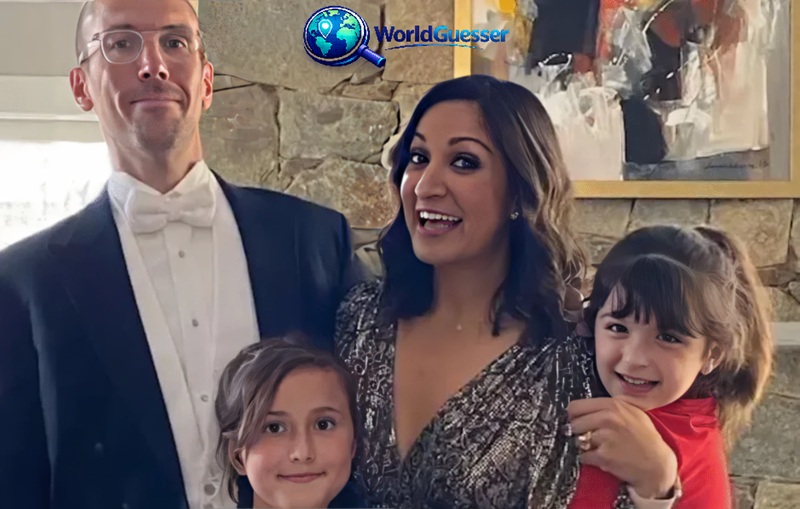
When Nawaz took the PBS NewsHour position in 2018 — a role that required her full professional presence in Washington and that offered a platform of significance neither of them could overlook — Werdel made the decision to leave the Times and become the family’s primary caregiver. It was a decision that required professional sacrifice from someone with a real and distinguished career, and both of them have spoken about it with a matter-of-factness that suggests it was a genuine partnership decision rather than a reluctant concession.
Their daughters — Karam and Lina — live with the family in Alexandria, Virginia, where Nawaz and Werdel have built the kind of household that their individual biographies suggest: intellectually engaged, professionally serious, grounded in values of public service and civic contribution that their parents demonstrate rather than merely espouse.
Amna Nawaz Net Worth: Public Journalism, Real Wealth
The financial reality of public broadcasting is specific and worth understanding clearly. PBS is a nonprofit public media organisation funded by a combination of government appropriations, viewer donations, and foundation support. Its compensation structures, while competitive for public media, are not comparable to the salaries of commercial network anchors at NBC, ABC, or CBS, where flagship anchors can earn between $8 million and $20 million annually.
Nawaz’s PBS NewsHour salary is estimated at between $100,000 and $200,000 annually — a figure that reflects senior anchor compensation in public broadcasting and that is consistent with the salary transparency mechanisms that nonprofit organisations are subject to. Beyond her base anchor salary, she commands speaking engagement honorariums in the range of $20,000 to $50,000 for major lectures, debate moderation roles, and conference appearances — a supplementary income stream consistent with her public profile and historic professional credentials.
| Amna Nawaz Net Worth: Income Breakdown | Estimated Amount |
|---|---|
| PBS NewsHour annual salary | $100,000–$200,000 |
| Speaking engagements (per event) | $20,000–$50,000 |
| NBC/ABC career accumulated savings (2001–2018) | Significant foundation |
| Alexandria, Virginia real estate | Asset contributor |
| Awards, fellowships, contributions | Non-cash recognition |
| Estimated Total Net Worth (2026) | $2 million – $3 million |
The net worth is genuine and appropriate to a career of two-plus decades in major American journalism. It is not the figure of a commercial network star. It is the figure of someone who chose public broadcasting’s combination of credibility, purpose, and stability over the higher salaries that commercial television might have eventually offered — and who built, in that choice, one of the most respected journalistic careers of her generation.
Conclusion
Amna Nawaz was born in Virginia in 1979 to Pakistani immigrant parents, grew up speaking four languages, attended one of America’s most rigorous public high schools, studied Politics, Philosophy, and Economics at the University of Pennsylvania, earned a master’s from the London School of Economics, became the first journalist inside North Waziristan, won an Emmy and a Peabody Award, founded a digital journalism platform, made history as the first Asian American and Muslim American to moderate a presidential debate, and now co-anchors and co-manages the most trusted evening news programme on American television. She has done all of this while raising two daughters with a husband who chose family over career to make it possible.
The net worth of $2 million to $3 million is the financial expression of that career. The career itself is worth considerably more — in credibility, in institutional trust, in the specific and irreplaceable contribution that a journalist of her skill, courage, and cultural fluency makes to the public’s ability to understand the world it inhabits.