
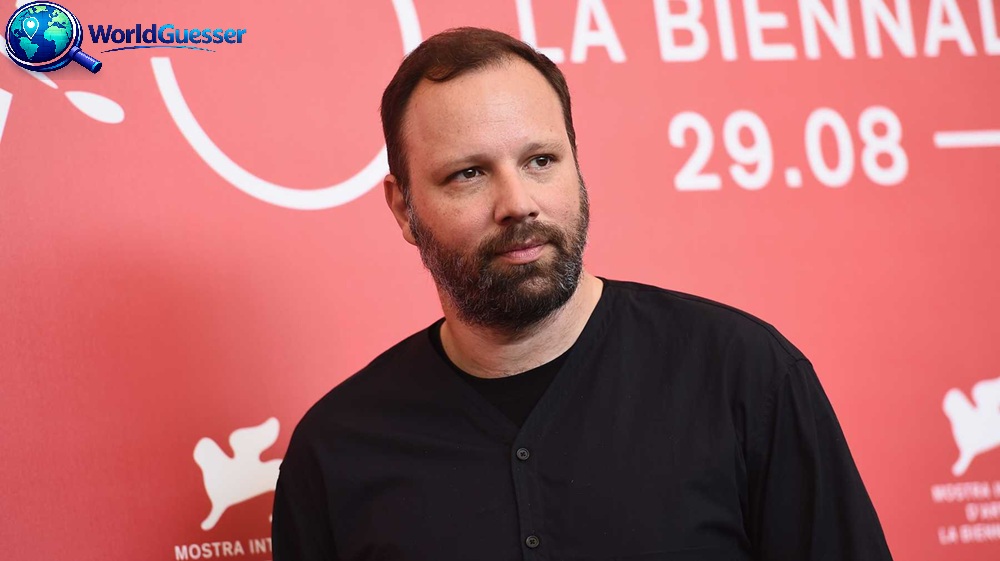
Who Is Yorgos Lanthimos
Yorgos Lanthimos is a Greek filmmaker widely regarded as one of the most singular and uncompromising directors working in cinema today. Born in the Pagrati neighbourhood of Athens in 1973, he spent the first decade of his career building a reputation in Greek experimental theatre and low-budget film before breaking internationally with Dogtooth in 2009. Since then, he has become an increasingly prominent figure in world cinema — a filmmaker whose work is instantly recognisable for its deadpan dialogue, clinical camerawork, absurdist premises, and unflinching examination of power, control, and social conformity.
His ascent from the margins of Greek independent film to multiple Oscar nominations and a Golden Lion represents one of contemporary cinema’s most distinctive trajectories. Rather than adapting his instincts to Hollywood conventions, Yorgos Lanthimos has reshaped the terms of prestige filmmaking around his own aesthetic — drawing major stars and studio resources into a universe that operates entirely by its own rules.
| Detail | Information |
|---|---|
| Full Name | Yorgos Lanthimos (Γιώργος Λάνθιμος) |
| Born | 23 September 1973, Pagrati, Athens, Greece |
| Nationality | Greek |
| Education | Moraitis School, Athens; Hellenic Cinema and Television School Stavrakos |
| Occupation | Film director, producer, screenwriter, theatre director |
| Years Active | 1995–present |
| Notable Films | Dogtooth (2009), The Lobster (2015), The Favourite (2018), Poor Things (2023), Bugonia (2025) |
| Awards | BAFTA Award, Golden Lion (Venice); six Academy Award nominations |
| Spouse | Ariane Labed (married 2013) |
| Residence | Athens, Greece |
From Athens to Film School
Lanthimos grew up primarily with his mother after his parents’ divorce when he was around nine years old. His father, Antonis Lanthimos, was a professional basketball player who represented both Pagrati BC and the Greek national team, and later taught basketball at the Moraitis School where Yorgos was educated. Lanthimos followed his father into the sport for a period, playing for Pagrati BC himself before stepping away around the age of nineteen.
The loss that defined his early years was sharper than sport: his mother died when he was seventeen, leaving him to look after himself through school and early employment. In interviews, Lanthimos has described the experience with characteristic understatement, saying only that he simply had to keep going. He initially enrolled in a business administration programme after school, but left at nineteen to join the Hellenic Cinema and Television School Stavrakos in Athens. It was in film school that his appetite for challenging cinema developed — he discovered the work of Andrey Tarkovsky, John Cassavetes, and Robert Bresson, and began absorbing literary influences including Samuel Beckett, Franz Kafka, and the playwright Sarah Kane. During the 1990s he directed dance videos for Greek choreographers, music videos, TV commercials, and short films, building the practical foundation that would underpin his later feature work.
The Greek-Language Films
Lanthimos co-directed his first feature, the mainstream Greek sex comedy My Best Friend, in 2001 alongside comedian Lakis Lazopoulos. The film found an audience in Greece but suited neither his temperament nor his ambitions. His first solo feature, Kinetta (2005), was a different proposition entirely — an avant-garde drama shot handheld, following three nameless characters re-enacting violent encounters at an empty hotel. It premiered at the Toronto International Film Festival and earned a place at Berlin, though critical response was mixed. It was the work of a director finding the particular register that would become his own.
Dogtooth (Kynodontas, 2009) announced that register to the world. The film depicts three adult siblings confined to a family compound by a controlling father who has systematically distorted their perception of language, danger, and the outside world. Shot with a static, observational precision that refuses to editorialise, it won the Un Certain Regard prize at Cannes and was nominated for the Academy Award for Best Foreign Language Film in 2011 — the first Greek film to receive that nomination in decades. The screenplay, co-written with frequent collaborator Efthimis Filippou, established the framework that would define Lanthimos’s Greek-language output: sealed social microcosms, language as a tool of domination, and human beings behaving with a strangeness that is simultaneously alien and recognisable.
Alps (2011) followed, a film about a group of people who offer to impersonate recently deceased individuals for grieving families. It won the Osella for Best Screenplay at Venice and Best Film at the Sydney Film Festival, though it never achieved the cultural impact of Dogtooth. Together, these three films positioned Lanthimos as one of the central figures of what critics called the Greek Weird Wave — a loose movement of filmmakers including Athina Rachel Tsangari whose work emerged during Greece’s economic crisis and reflected a country under profound social strain.
Key Films at a Glance
| Film | Year | Festival | Key Award |
|---|---|---|---|
| Kinetta | 2005 | Toronto, Berlin | — |
| Dogtooth | 2009 | Cannes | Un Certain Regard Prize |
| Alps | 2011 | Venice | Osella for Best Screenplay |
| The Lobster | 2015 | Cannes | Jury Prize |
| The Killing of a Sacred Deer | 2017 | Cannes | Best Screenplay |
| The Favourite | 2018 | Venice | Grand Jury Prize |
| Poor Things | 2023 | Venice | Golden Lion |
| Kinds of Kindness | 2024 | Cannes | Best Actor (Jesse Plemons) |
| Bugonia | 2025 | — | 4 Academy Award nominations |
Breaking Into English
The move to English-language filmmaking was enabled by the international attention Dogtooth had generated, and Lanthimos relocated to London in 2011. The Lobster (2015) was the result — a dark comedy co-written with Filippou and starring Colin Farrell as a recently divorced man who, in a near-future society, must find a romantic partner within 45 days or be transformed into an animal of his choice. The premise was pure Lanthimos: a social contract rendered grotesque, the ordinary logic of coupling pushed to its clinical extreme. Shot with cinematographer Robbie Ryan, who would become a key long-term collaborator, the film screened in Competition at Cannes and won the Jury Prize. Lanthimos received his first Academy Award nomination for Best Original Screenplay.
The Killing of a Sacred Deer (2017) reunited him with Farrell alongside Nicole Kidman and a then-emerging Barry Keoghan. A psychological horror built around a surgeon whose family is subjected to a biblical logic of sacrifice and retribution, it premiered at Cannes and won Best Screenplay. The film was more polarising than The Lobster — its refusal of psychological realism tested audiences accustomed to horror that explains itself — but it confirmed that Lanthimos was not moderating his instincts for a larger audience. He had brought international stars into his world rather than the reverse.
The Favourite and the Oscar Campaign
The Favourite (2018) marked the point at which the mainstream stopped resisting and leaned in. A period dark comedy set in the court of Queen Anne, it starred Olivia Colman, Emma Stone, and Rachel Weisz in a study of political manipulation and emotional cruelty dressed in the costumes of 18th-century England. The screenplay, written by Tony McNamara rather than Filippou, gave Lanthimos his most verbally dexterous material to date, and Ryan’s fisheye wide-angle photography — gleaming corridors, candles, and characters observed at an unsettling distance — made the claustrophobia of court feel both sumptuous and suffocating.
The film won the Grand Jury Prize at Venice and then navigated a full awards season, earning ten Academy Award nominations including Best Picture and Best Director. Olivia Colman won the Oscar for Best Actress. The tally tied it with Alfonso Cuarón’s Roma as the most-nominated film of that ceremony. For a director who had made his name in Greek avant-garde cinema, the scale of the recognition was remarkable — and Yorgos Lanthimos navigated it without any visible compromise to his approach.
Poor Things and Peak Lanthimos
Poor Things (2023) arrived as the culmination of everything Lanthimos had been building toward. Based on Alasdair Gray’s 1992 novel, it stars Emma Stone as Bella Baxter — a woman restored to life with the brain of her unborn child, who then proceeds to discover the world with total, unconditioned freedom. Designed as a maximalist Victorian fantasia, shot largely in Budapest with production designer James Price creating an entirely artificial world of impossible architecture and anachronistic technology, it was the most visually extravagant film Lanthimos had made.
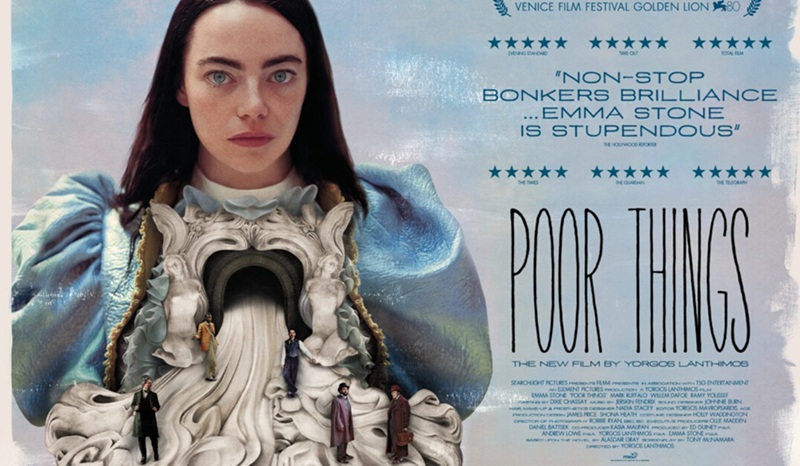
The film premiered at the 80th Venice International Film Festival, where it won the Golden Lion. It then received eleven Academy Award nominations and won four: Best Actress for Emma Stone, Best Production Design, Best Costume Design, and Best Makeup and Hairstyling. Stone’s performance — physical, fearless, and constructed around the logic of a person with no internalised shame — gave the film its emotional centre. Lanthimos himself was nominated for Best Director. The Greek government responded with unusual public pride: Prime Minister Kyriakos Mitsotakis praised the film’s global recognition, and Culture Minister Lina Mendoni described the wins as establishing Lanthimos as a creator of worldwide appeal.
Watch trailer on Here – https://www.youtube.com/watch?v=RlbR5N6veqw
The Lanthimos Style
The consistency of Lanthimos’s approach across radically different settings — a Greek family compound, a luxury hotel in a near-future dystopia, the court of Queen Anne, a Victorian steampunk world — points to a set of concerns more durable than genre or period. His films are built around power: who holds it, how it is transferred, and how human beings construct and submit to arbitrary systems of control. Emma Stone has observed that the question of who is in charge runs through everything he makes, and the mechanisms of that control — language, ritual, violence, desire — change form from film to film while the underlying inquiry remains constant.
Technically, his signature is the wide-angle lens combined with a static or slowly drifting camera that observes without commenting. Cinematographer Robbie Ryan, who shot The Favourite, Poor Things, Kinds of Kindness, and Bugonia, has become as important to the visual identity of the late work as Filippou was to the Greek-language scripts. The dialogue in Lanthimos’s films is characteristically flat and declarative, stripped of the inflections that signal emotional subtext — actors are asked to mean exactly what they say, no more, which produces an uncanny effect in which normal sentences sound strange and strange sentences sound perfectly reasonable. Colin Farrell has described Lanthimos’s refusal to provide character backstory on set as a method of forcing actors to live entirely within the present of each scene.
Kinds of Kindness and Bugonia
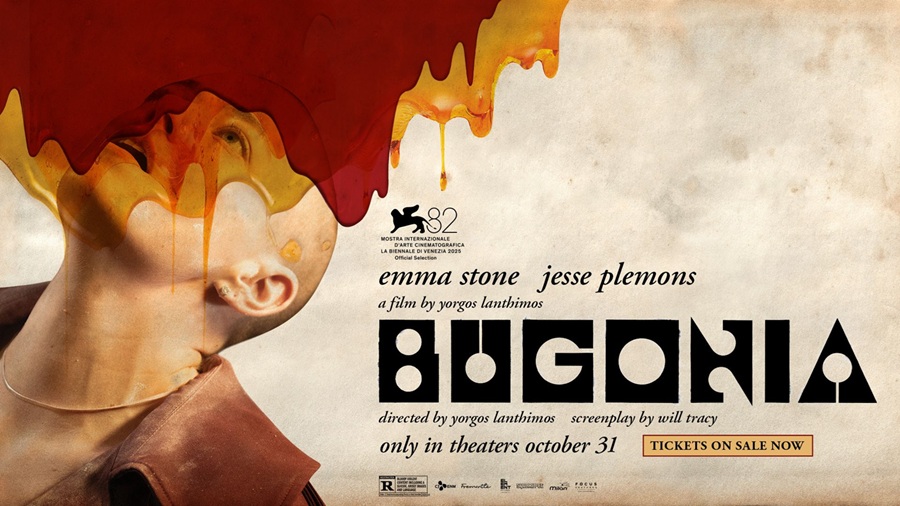
Kinds of Kindness (2024) represented a deliberate step back from the scale of Poor Things. A triptych of loosely connected stories written with Filippou — marking their fifth collaboration — the film cast Stone, Jesse Plemons, Willem Dafoe, Margaret Qualley, and Hong Chau each in multiple roles across the three parts. It premiered in Competition at Cannes, where Plemons won Best Actor, and arrived to divided critical opinion: Rotten Tomatoes described it as Lanthimos at his most misanthropic, while others called it a return to the austere directness of his earlier Greek-language work. It was the least commercially accessible film he had made since Alps, but it signalled that his prolific recent phase would not settle into a more palatable register.
Bugonia (2025) continued the collaboration with Stone and Plemons in a remake of Jang Joon-hwan’s South Korean sci-fi comedy Save the Green Planet! (2003). With a screenplay by Will Tracy (known for Succession and The Menu), the film follows two conspiracy-minded men who kidnap a pharmaceutical CEO they believe to be an alien. Stone, bald for the role, plays the CEO; Plemons plays the increasingly unstable kidnapper. The film debuted on 26 November 2025 and earned four Academy Award nominations, including Best Picture — extending Lanthimos’s unbroken run of Oscar recognition across four consecutive films.
Watch trailer on Here – https://www.youtube.com/watch?v=bd_5HcTujfc
Personal Life
Lanthimos met French-Greek actress Ariane Labed while working as a producer and actor on Athina Rachel Tsangari’s Attenberg in 2010. They married in 2013 and lived in London from 2011 until 2021, when they relocated back to Athens. Both have spoken about the return as a deliberate choice; Labed has described Athens as her favourite city, drawn to what she calls its chaotic quality — the sense that value is not rigidly assigned to things, which she finds liberating. Lanthimos has expressed similar feelings about the generosity and informality of working in Greece, and has noted that the collaborative spirit of his Athens years shaped how he organises film sets regardless of scale.
Beyond film, Lanthimos is a working photographer. Three books of his photography have been published: Dear God, the Parthenon is still broken, I shall sing these songs beautifully, and Viscin. He was part of the creative team that designed the opening and closing ceremonies of the 2004 Athens Olympics, and has continued to direct for theatre. His influences — Beckett, Kafka, Bresson, Tarkovsky, Diane Arbus, Sarah Kane — suggest an artist who absorbs across forms, and his set design instincts, his photographer’s eye, and his theatre background are visibly present in the architecture of his films.
A Director Who Refuses Resolution
The arc of Yorgos Lanthimos’s career — from Athenian experimental theatre to four consecutive Oscar-nominated films, all made without visible aesthetic compromise — is a demonstration that cinema’s most challenging sensibilities can find the largest audiences if given sufficient time and the right conditions. He has described himself as someone with no interest in making films that resolve pleasantly, and no appetite for stories that already know their own meaning. What he offers instead is something rarer: films that construct their own logic with complete internal consistency and then leave audiences to inhabit the discomfort that logic produces. In a landscape of sequels, reboots, and algorithmically tested narratives, his continued ability to draw major talent and global attention to that particular kind of discomfort remains, in itself, a strange and extraordinary fact.