
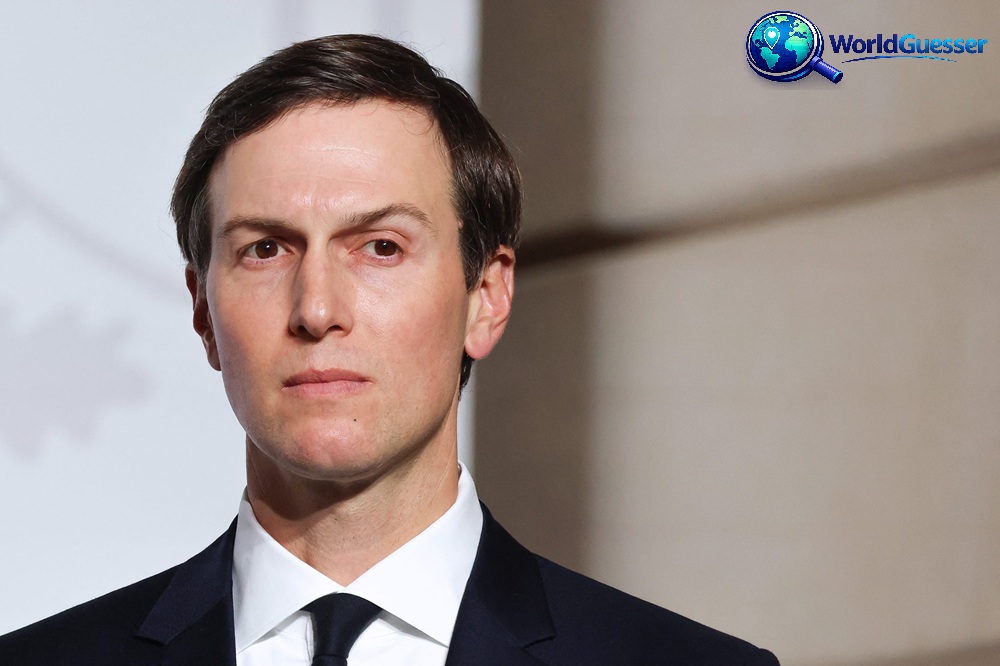
| Quick Facts | Details |
|---|---|
| Full Name | Jared Corey Kushner |
| Date of Birth | January 10, 1981 |
| Birthplace | Livingston, New Jersey, USA |
| Age (2026) | 44 years old |
| Height | 6 ft 3 in (190 cm) |
| Religion | Orthodox Jewish |
| Parents | Charles Kushner (real estate developer; convicted felon; US Ambassador to France 2025); Seryl Kushner (née Stadtmauer) |
| Siblings | Dara Kushner; Nicole Kushner Meyer; Joshua Kushner |
| Education | Harvard College — B.A. Government (2003); NYU Law + Stern — J.D./M.B.A. (2007) |
| Company taken over | Kushner Companies — 2005, age 24, after father’s conviction |
| New York Observer | Purchased 2006 for $10 million; sold 2017 |
| 666 Fifth Avenue | Purchased 2007 for $1.8 billion — age 26 |
| Wife | Ivanka Trump — married October 25, 2009 (converted to Judaism) |
| Children | Arabella Rose (2011); Joseph Frederick (2013); Theodore James (2016) |
| White House role | Senior Advisor to the President — January 2017 to January 2021 |
| Key policy achievements | Abraham Accords (2020); First Step Act (2018); USMCA trade agreement |
| Thyroid cancer | Diagnosed October 2019; second surgery August 2022 |
| Affinity Partners | Founded 2021; Miami; $4.8 billion AUM (March 2025); $2 billion from Saudi PIF |
| EA acquisition | September 2025 — $52.5–55 billion buyout of Electronic Arts with PIF + Silver Lake — largest LBO in history |
| Brain Co. | AI startup co-founded with Elad Gil, September 2025 |
| Memoir | Breaking History: A White House Memoir (HarperCollins, August 2022) |
| Residence | Indian Creek Village, Miami — $24 million home |
| 2025 diplomacy | December 2025 — met Vladimir Putin for ~5 hours in Moscow re: Ukraine ceasefire |
| Net worth (2026 est.) | $1 billion+ (Forbes confirmed billionaire status September 2025) |
In September 2025, Jared Kushner — the forty-four-year-old real estate heir, former White House Senior Advisor, and investment fund manager — joined, alongside the Saudi Public Investment Fund and Silver Lake Partners, in the acquisition of Electronic Arts for approximately $52.5 to $55 billion: the largest leveraged buyout ever recorded in the history of American private equity, executed through his Miami-based fund Affinity Partners, which by March of the same year had accumulated $4.8 billion in assets under management from a standing start in 2021.
The transaction confirmed what Forbes had formally established that same month: Jared Kushner was a billionaire.
Four years earlier, he had left the White House with a net worth that various estimates placed at between $200 million and $800 million — the accumulated result of his real estate career, his partial exit from the online real estate platform Cadre, and the specific combination of assets and liabilities that a 20-year career in New York and New Jersey property development had produced. The trajectory from that figure to the EA transaction’s scale, executed in the four years between his White House departure and Forbes’s September 2025 confirmation, is one of the more remarkable individual wealth accumulation stories in recent American financial history.
It is also a story that cannot be told without the context it sits within: the father’s conviction, the Harvard education controversy, the $1.8 billion purchase of a Manhattan skyscraper at twenty-six years old, the marriage to the President’s daughter, the White House years during which he operated without formal foreign policy credentials at the centre of some of the most consequential diplomatic initiatives of the Trump administration, the cancer diagnosis conducted in secret, and the memoir that tried to account for all of it.
Livingston, New Jersey: The Foundation
Jared Corey Kushner was born on January 10, 1981, in Livingston, New Jersey — the Essex County suburb whose Orthodox Jewish community had shaped his mother Seryl’s upbringing a generation earlier, and that provided the specific formation of his own childhood: Orthodox Jewish practice, day school education, the values of a family whose grandparents had survived the Holocaust and whose father was building one of the most significant real estate development businesses in New Jersey.
His grandfather Joseph Kushner — a Holocaust survivor who arrived in the United States in the postwar years and built the Kushner Companies real estate operation from nothing in Newark — was the foundational figure whose story defined the family’s identity. The specific combination of immigrant resourcefulness, Orthodox Jewish faith, and the particular hunger of someone who had survived the attempt to eliminate his people informed everything the Kushner family built — and informed Jared’s own understanding of what he was heir to.
Benjamin Netanyahu — the Israeli Prime Minister whose relationship with the Kushner family predates his most recent terms in office — slept in Jared’s childhood bedroom when he visited the Kushner home in Livingston. The detail captures something specific about the social geography of the Orthodox Jewish community’s relationship to Israeli politics: the two worlds were not separate. They were the same world, with the Atlantic Ocean in between.
Jared attended the Frisch School — the Orthodox Jewish day school in Paramus, New Jersey, whose alumni include multiple figures in Jewish professional and public life — before the admission to Harvard that would become one of the most discussed and most disputed facts of his educational biography.
Harvard and the $2.5 Million Question
In 1999, Jared Kushner was admitted to Harvard College — an admission that the journalist Daniel Golden subsequently reported, in his book The Price of Admission (2006), had been preceded by a $2.5 million pledge from his father Charles Kushner to the university. Golden’s account, drawing on multiple sources including a former admissions official who described Jared as “not anywhere near the top” of the applicant pool by academic standard, created one of the more persistent controversies of Jared Kushner’s biography: the allegation that a college admission was purchased rather than earned.
Charles Kushner has denied that the donation influenced the admission decision. Harvard has maintained its standard position of not commenting on individual admission cases. The allegation has never been adjudicated in any legal or academic proceeding. What is not disputed is the sequence of facts: the $2.5 million pledge, the admission, and the graduating class of 2003 that produced a Bachelor of Arts in Government.
At Harvard, Jared demonstrated that whatever the circumstances of his admission, his time there was not wasted. He made his first significant real estate deal — Somerville Building Associates, a $20 million transaction — while still an undergraduate, executing it with the practical intelligence of someone who had grown up in a real estate household and understood the mechanics of the business from childhood. The deal was evidence of a quality that his subsequent career would consistently demonstrate: Jared Kushner learns fast, executes with confidence, and is not deterred by the scale of what he is attempting relative to his experience.
He went on to NYU School of Law and NYU Stern School of Business simultaneously, earning both a J.D. and an M.B.A. in 2007 — a dual degree whose combination of legal and business training was exactly suited to the real estate development career he was preparing for and which gave him the professional credentials that the family business required of its incoming generation.
Taking the Wheel at 24: The Company After Charles’s Conviction
In 2004, Charles Kushner pleaded guilty to 18 federal felony counts — tax evasion, illegal campaign contributions, and witness tampering — and in March 2005 was sentenced to two years in federal prison. He served 14 months at the Federal Prison Camp in Montgomery, Alabama.
Jared Kushner was twenty-four years old. He stepped into the operational leadership of Kushner Companies — a real estate development business whose portfolio spanned New Jersey, New York, and several other markets, and whose management in the absence of its founder required someone with both the family trust and the professional capability to hold the organisation together during the specific crisis of a founder’s imprisonment.
The assumption of leadership at twenty-four, under those circumstances, is the biographical fact that most clearly establishes the specific quality of Jared Kushner’s professional identity: the willingness to take responsibility for something large and difficult at an age when most of his contemporaries were still establishing the early stages of their careers. He ran the company. He managed the portfolio. He made decisions. And when his father was released from prison, the company he returned to was still standing.
In 2006, Jared purchased the New York Observer — the Manhattan weekly newspaper whose salmon-coloured pages and specific cultural niche at the intersection of New York real estate, media, and political commentary made it, under his ownership, a platform for both journalism and opinion. He paid $10 million. He turned it profitable. He sold it in 2017, when his White House role made the media ownership untenable. The Observer chapter is one of the more underappreciated dimensions of his biography: a young man buying a newspaper, learning the media business, and running it with sufficient competence to produce a return on the investment.
666 Fifth Avenue: The Deal That Defined a Decade
In 2007, Jared Kushner purchased 666 Fifth Avenue — the 41-story Midtown Manhattan office tower at the corner of 52nd Street — for $1.8 billion. He was twenty-six years old. The deal was financed with approximately $50 million in equity and $1.75 billion in debt — a leverage ratio that reflected both the specific optimism of the pre-financial crisis commercial real estate market and the specific audacity of a twenty-six-year-old willing to bet his company’s balance sheet on a single building.
The timing was catastrophic. The 2008 financial crisis hit the commercial real estate market with precisely the force that a maximally leveraged acquisition cannot absorb. The building’s value fell below the debt secured against it. The vacancy rate rose. The carrying costs of the debt became increasingly difficult to service. 666 Fifth Avenue became the most prominent and most discussed albatross in the Kushner Companies portfolio — a deal that, had the market not eventually recovered and had the Brookfield Asset Management deal not eventually refinanced the property in 2018, might have defined Jared Kushner’s career in terms of its single largest failure rather than its broader trajectory.
The Brookfield deal — in which Brookfield took a 99-year lease on the building and effectively removed the debt crisis from the Kushner Companies balance sheet — was, in its timing, notable: it was completed in August 2018, while Jared Kushner was serving as Senior Advisor in the Trump White House, and while Brookfield had interests in multiple areas where White House policy was relevant. The coincidence attracted significant congressional scrutiny. No legal action resulted.
Ivanka Trump and the Marriage That Reshapes Everything
Jared Kushner met Ivanka Trump in 2007 at a lunch arranged by mutual real estate contacts — two people from New York’s property development world, both children of famous and controversial fathers, introduced at the intersection of their professional worlds. The relationship that developed was, by multiple accounts, genuine and intense.
It was also, from Seryl Kushner’s perspective, initially unacceptable. Ivanka was not Jewish. As we documented in the Seryl Kushner article, the maternal resistance was real — Jared and Ivanka briefly separated in 2008 under the pressure of that resistance before Ivanka’s decision to undertake a formal Orthodox conversion under Rabbi Haskel Lookstein resolved the impasse.
They married on October 25, 2009, at Trump National Golf Club in Bedminster, New Jersey — a wedding that brought together two of New York’s most prominent real estate dynasties and that, in retrospect, was the event that would eventually reorganise American politics in specific ways that neither family could have anticipated. Their daughter Arabella Rose Kushner was born in July 2011. Their son Joseph Frederick Kushner was born in October 2013. Their second son Theodore James Kushner was born in March 2016 — the same year that Donald Trump’s presidential campaign, which Ivanka and Jared both supported and advised, began its improbable march to the White House.
The White House Years: Power Without Portfolio
When Donald Trump was inaugurated as the 45th President of the United States on January 20, 2017, Jared Kushner was named Senior Advisor to the President — a White House position whose specific mandate was deliberately undefined, allowing it to expand to encompass whatever the President decided it should encompass. Jared received a security clearance — initially temporary, eventually permanent after a prolonged process — and was assigned responsibility for an agenda whose breadth was, by any standard measure of what a single staff position should contain, extraordinary.
The 1967 anti-nepotism statute was challenged immediately. The Department of Justice’s Office of Legal Counsel issued an opinion concluding that the statute applied to executive branch agencies but not to White House staff positions — a reading whose legal plausibility was disputed but which was sufficient to allow the appointment to proceed.
His portfolio included Middle East peace, the USMCA trade agreement renegotiation, criminal justice reform, opioid policy, and various other domestic and international assignments that rotated through his office across the four years of the first Trump administration. The breadth of the assignment was simultaneously the most frequent criticism of his role — the argument that assigning one person without relevant credentials to an impossible range of subjects was a recipe for superficiality — and the most distinctive feature of what he actually achieved.
The First Step Act, signed into law in December 2018, was Jared Kushner’s most unambiguously successful legislative achievement — a bipartisan criminal justice reform bill that reduced mandatory minimum sentences for certain drug offences, expanded early release mechanisms, and produced a broadly positive assessment from criminal justice reform advocates across the political spectrum. The bill passed the Senate 87–12 and the House 358–36. Its passage was the result of sustained coalition-building across Republican and Democratic legislators by Kushner’s team, and it produced a genuinely significant change in federal sentencing policy.
The Abraham Accords — the normalisation agreements between Israel and the United Arab Emirates (August 13, 2020), Bahrain (September 11, 2020), Sudan (October 23, 2020), and Morocco (December 10, 2020) — were the foreign policy achievement whose scale was, in historical terms, the most significant of the Trump administration’s Middle East work. For decades, the prevailing assumption in American Middle East diplomacy had been that Arab normalisation with Israel required a prior Israeli-Palestinian peace settlement. The Abraham Accords demonstrated that normalisation was achievable without that precondition, by focusing on the shared strategic interests of Israel and the Gulf states in containing Iranian influence. Jared Kushner’s role in the negotiations was acknowledged by all parties to the agreements and by independent diplomatic analysts as central to their completion.
In October 2019, during the White House years, Jared was diagnosed with thyroid cancer — a fact he did not disclose publicly until later, undergoing surgery and treatment while continuing his White House work. He underwent a second surgery in August 2022. Thyroid cancer, when diagnosed early, typically carries a favourable prognosis; both treatments appear to have been successful.
Affinity Partners and the Billion-Dollar Chapter
Jared Kushner founded Affinity Partners in 2021, shortly after leaving the White House — a Miami-based private equity and investment management firm whose initial fundraising produced approximately $2 billion from the Saudi Public Investment Fund (PIF), the sovereign wealth fund controlled by Crown Prince Mohammed bin Salman. The Saudi investment generated immediate and sustained controversy: Kushner’s White House role had included significant engagement with Saudi Arabia, MBS had been identified by US intelligence agencies as having ordered the murder of journalist Jamal Khashoggi, and the $2 billion investment arrived just months after Kushner’s departure from government service.
Congressional scrutiny of the investment was significant. Kushner maintained that the firm’s investment process and its management fee structure were standard, that the Saudi investment was made on commercial terms, and that the work he did for Affinity Partners was independent of his former White House relationships. The controversy did not produce legal action.
By March 2025, Affinity Partners had grown its assets under management to $4.8 billion — a figure that reflected the firm’s expansion beyond its initial Saudi capital base into a broader range of institutional and sovereign wealth fund investors. Additional investments came from Gulf state sovereign wealth funds, European family offices, and other institutional allocators.
In September 2025, Affinity Partners participated — alongside the Saudi PIF and Silver Lake Partners — in the acquisition of Electronic Arts for approximately $52.5 to $55 billion: the largest leveraged buyout in the history of private equity, surpassing the previous record held by the 2007 buyout of TXU Energy. The EA deal placed Affinity Partners at the centre of one of the most consequential transactions in the entertainment and gaming industry’s history, and confirmed the scale of the firm’s ambitions and capabilities.
In the same month, Kushner co-founded Brain Co. — an artificial intelligence startup — alongside veteran Silicon Valley investor Elad Gil, adding a technology venture dimension to the investment portfolio. He also acquired an 8% stake in OakNorth, the British fintech bank, in August 2025.
Forbes confirmed Kushner’s billionaire status in September 2025 — the formal acknowledgement of a wealth accumulation trajectory that had converted a significant but sub-billion net worth at the time of his White House departure into a ten-figure fortune in approximately four years.
Breaking History, Ukraine, and the Ongoing Public Life
In August 2022, Jared Kushner published Breaking History: A White House Memoir through HarperCollins — an account of his time as Senior Advisor that presented the Abraham Accords, the First Step Act, and the administration’s Middle East Peace Plan as the genuine achievements of a period that public opinion had assessed with considerably more ambivalence. The book was received with the specific mixture of serious engagement and partisan scepticism that White House memoirs from controversial figures typically generate.
In December 2025, Kushner traveled to Moscow alongside Steve Witkoff — the Trump administration’s Special Envoy for Middle East and Ukraine — and met with Vladimir Putin for approximately five hours in discussions related to potential ceasefire negotiations in Ukraine. The meeting reflected his ongoing role as an informal diplomatic resource in Trump’s second administration, and his specific relationship with both Gulf state leaders and the Israeli government giving him access and credibility that formal diplomatic channels do not always produce.
He and Ivanka live in Indian Creek Village — the exclusive Miami-area island community whose residents have included Carl Icahn, Julio Iglesias, and other figures of significant wealth — in a home valued at approximately $24 million. Jared joined the Indian Creek Village council on July 8, 2024. Their three children — Arabella, Joseph, and Theodore — attend school in Miami.
Net Worth: The Billionaire Confirmed
| Income/Asset Source | Estimated Contribution |
|---|---|
| Kushner Companies real estate portfolio | Historic and ongoing |
| 666 Fifth Avenue — eventual refinancing gain | Recovered from crisis |
| New York Observer — sold 2017 | Modest return on $10M investment |
| Cadre — partial stake sale | $25–50 million (est.) |
| White House years (no salary drawn, assets managed separately) | Maintained |
| Affinity Partners — management fees + carried interest (2021–present) | Primary current wealth driver |
| Saudi PIF $2B investment (2021) | Fee-generating base |
| Affinity Partners AUM $4.8B (March 2025) | Ongoing fee generation |
| Electronic Arts acquisition (September 2025) | Transformative transaction |
| Brain Co. (AI startup, September 2025) | Early stage |
| OakNorth 8% stake (August 2025) | Significant fintech investment |
| Confirmed Net Worth (Forbes, September 2025) | Billionaire |
Conclusion
Jared Kushner was born in Livingston, New Jersey, on January 10, 1981, the son of a real estate developer who would go to prison and a mother who would not meet his girlfriend until she converted to Judaism. He was admitted to Harvard with a father who had donated $2.5 million. He took over the family company at twenty-four when his father was convicted of 18 felonies. He bought 666 Fifth Avenue at twenty-six for $1.8 billion and nearly lost it in the financial crisis. He married the President’s daughter after she converted to Judaism for him. He served as Senior Advisor in the White House without formal credentials, brokered the most significant Arab-Israeli normalisation agreements in a generation, passed a bipartisan criminal justice reform bill, was diagnosed with cancer and said nothing, left the White House, founded a private equity firm, raised $2 billion from Saudi Arabia, grew it to $4.8 billion, participated in the largest leveraged buyout in history, co-founded an AI startup, became a confirmed billionaire, and met Vladimir Putin for five hours in Moscow.
He is forty-four years old. His father is the American Ambassador to France. His wife is considering a Senate run. His children attend school in Miami. His grandfather survived the Holocaust and built houses in Newark.
Jared Kushner is, by the specific evidence of what the past twenty years have contained, a man who operates at the intersection of every major force in American life — real estate, politics, technology, Middle East diplomacy, private equity, and the specific gravity of a family whose story is inseparable from the story of the country — without being fully explainable by any single one of them.