
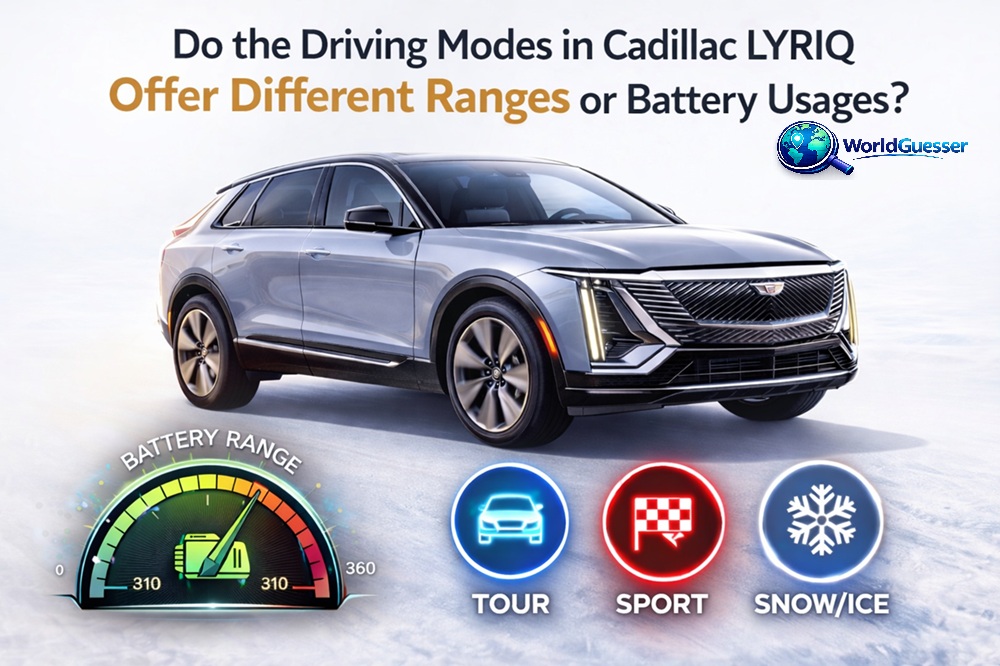
The Cadillac LYRIQ is one of the most compelling luxury electric SUVs on the American market — a vehicle that blends the refinement of the Cadillac name with the intelligent engineering demands of the electric era. One question that surfaces consistently among LYRIQ owners and prospective buyers is a practical one: do the driving modes actually change how far the car can go, or how quickly the battery drains? The answer is yes — but the full picture is more nuanced than a simple mode-by-mode comparison suggests. Understanding how each setting works, what it changes under the hood, and how driving behaviour interacts with those changes is the key to getting the most from every charge.
The LYRIQ at a Glance
| Specification | Detail |
|---|---|
| Vehicle Type | Luxury Electric SUV |
| Battery Pack | 102 kWh Ultium platform |
| EPA Range (RWD) | 314 miles |
| EPA Range (AWD) | 307 miles |
| Energy Consumption | Approx. 25–30 kWh per 100 miles (Tour Mode, ideal conditions) |
| Available Drive Modes | Tour, Sport, Snow/Ice, My Mode |
| Regenerative Braking | Adjustable; One-Pedal Driving available |
| Charging Recommendation | Cadillac recommends 80% for daily use |
What Driving Modes Actually Change
Before examining each mode individually, it is worth understanding what driving modes do — and do not — change in the LYRIQ. The battery itself remains constant. The 102 kWh Ultium pack does not grow or shrink depending on which mode is selected. What changes is the software layer that governs how that stored energy is accessed and delivered.
Specifically, driving modes adjust throttle mapping — the relationship between how far the driver presses the accelerator pedal and how much torque the electric motors produce in response. They also influence steering weight, traction control sensitivity, regenerative braking behaviour, and in AWD models, the torque split between front and rear axles. These are calibration changes, not hardware changes. But calibration changes have real consequences for efficiency, because the pattern in which current is drawn from a battery pack — steadily and smoothly, or in sharp aggressive spikes — directly determines how efficiently that energy is converted into forward motion.
Tour Mode: The Efficiency Benchmark
Tour Mode is the LYRIQ’s default setting and the one against which all other modes should be measured for efficiency purposes. In Tour, the throttle mapping is linear and progressive — the relationship between pedal input and motor output is deliberately smoothed, encouraging controlled, predictable acceleration that avoids the sharp current spikes that reduce efficiency.
In practical terms, Tour Mode is calibrated to align closely with the conditions under which the EPA tests and certifies range figures. Rear-wheel drive LYRIQ models achieve an EPA-estimated 314 miles in this configuration. All-wheel drive models return 307 miles. For drivers maintaining steady speeds on highways, smooth acceleration in city traffic, and consistent use of regenerative braking, real-world figures in Tour Mode can approach those estimates closely.
The mode also makes the most effective use of regenerative braking — the system by which the LYRIQ recaptures kinetic energy during deceleration and returns it to the battery. In Tour, regenerative braking is active and consistent, and drivers who combine it with One-Pedal Driving can meaningfully extend their range in stop-and-go urban conditions.
Tour Mode is the right choice for daily commuting, long highway journeys, and any scenario where maximising distance on a single charge is the priority.
Sport Mode: Performance at a Cost
Sport Mode is where the LYRIQ’s character changes most dramatically — and where the trade-off between driving enjoyment and battery efficiency becomes most visible.
In Sport, the throttle mapping is sharpened significantly. A smaller pedal movement commands a much larger torque response, making the car feel immediately more reactive and energetic. In AWD models, Sport Mode shifts the torque split to favour the rear axle, producing a more dynamic, rear-driven feel that transforms the character of the vehicle on winding roads and open highways. The steering feels heavier and more communicative. The brake pedal response becomes more immediate.
All of this comes at a measurable cost to range. The sharper throttle response increases the likelihood of high-current draw events — moments where the motors are pulling significant power from the battery in rapid succession. Over the course of a typical drive, the cumulative effect of those spikes reduces average efficiency noticeably. Most sources and owner accounts point to a range reduction of roughly 10 to 20 percent compared to Tour Mode. For a car rated at 314 miles, consistent aggressive driving in Sport Mode can bring real-world range down to approximately 250 to 280 miles before a charge is needed.
It is worth noting, however, that the reduction is behavioural as much as it is mechanical. A driver who selects Sport Mode but maintains smooth, measured inputs may see only a modest drop in efficiency. The mode sets the calibration; driving style determines the real-world outcome.
Sport Mode is best suited to short trips, spirited driving on open roads, highway merging, and situations where performance takes precedence over range management. Drivers running low on charge are well advised to switch back to Tour.
Mode Comparison: Range Impact
| Mode | Throttle Response | Typical Range Impact | Best Used For |
|---|---|---|---|
| Tour | Smooth, progressive | Baseline (up to 314 miles RWD) | Daily driving, long trips |
| Sport | Sharp, immediate | 10–20% reduction (~250–280 miles) | Performance, short trips |
| Snow/Ice | Softened, gentle | Slight reduction; varies with conditions | Winter driving, low-traction surfaces |
| My Mode | User-defined | Depends entirely on custom settings | Personalised balance of comfort and efficiency |
Snow/Ice Mode: Safety First, Efficiency Second
Snow/Ice Mode is the LYRIQ’s answer to low-traction driving conditions, and its effect on range is more contextual than the Tour-to-Sport comparison. In this mode, throttle sensitivity is deliberately reduced — small pedal inputs produce gentler torque delivery, minimising the risk of wheel spin on icy or slippery surfaces. Traction control and stability systems are calibrated to intervene earlier and more proactively, maintaining grip at the expense of outright performance.
The efficiency implications are modest in isolation. Snow/Ice Mode does not demand the same high-current draw that Sport Mode can generate, and its softened throttle response can actually prevent the energy waste that comes from wheel spin on slippery surfaces. However, the mode is most commonly used in winter conditions — and cold weather is independently one of the most significant factors in reducing EV range. Low temperatures increase the battery’s internal resistance, reduce its available capacity, and require the thermal management system to work harder to keep the pack within its optimal temperature range. Cabin heating in cold weather, which draws from the same battery, adds further to the load.
The practical conclusion is that Snow/Ice Mode used on genuinely slippery roads in cold weather will produce lower range than Tour Mode used in mild conditions — but that reduction is primarily driven by the weather rather than the mode itself. Used on clear, dry roads, Snow/Ice Mode is less efficient than Tour because it does not allow the regenerative braking system to operate at its most effective, but the difference is relatively small.
My Mode: The Personalisation Variable
My Mode is the LYRIQ’s most flexible setting and the hardest to characterise in efficiency terms, because its impact depends entirely on how the driver configures it. Through the vehicle’s digital interface, My Mode allows independent adjustment of throttle response, steering weight, brake feel, regenerative braking intensity, and in some configurations, suspension characteristics.
The range of outcomes is therefore broad. A driver who configures My Mode with a Sport-level throttle response and heavy steering will see efficiency figures broadly similar to Sport Mode. A driver who dials in a gentle throttle response and maximises regenerative braking intensity may achieve efficiency that matches or even exceeds Tour Mode. The flexibility is genuine and meaningful.
My Mode’s most useful application is for drivers who want specific combinations that the fixed modes do not offer — Sport steering feel with Tour-level acceleration response, for instance, which preserves efficiency while keeping the car feeling engaged and communicative. This kind of personalised configuration can meaningfully extend range compared to full Sport Mode while maintaining a driving character that Tour Mode alone does not provide.
Regenerative Braking: The Mode-Adjacent Efficiency Tool
Running alongside the driving modes is the LYRIQ’s regenerative braking system, which is adjustable independently and has a significant influence on real-world range regardless of which mode is active. Regenerative braking captures kinetic energy during deceleration — energy that would otherwise be lost as heat through conventional friction brakes — and converts it back into electrical energy that is returned to the battery.
One-Pedal Driving takes this further by allowing the car to decelerate to a complete stop simply by lifting off the accelerator, without touching the brake pedal. In urban driving with frequent stops, this system can recover a meaningful amount of energy over the course of a journey. Drivers who develop the habit of anticipating stops and modulating deceleration through regeneration rather than braking can see noticeable improvements in efficiency across all driving modes.
What Matters More Than Mode Selection
The research on LYRIQ driving modes consistently points to one conclusion that deserves its own emphasis: driving style is a more significant determinant of real-world range than mode selection alone. The mode sets the vehicle’s calibration; what the driver does within that calibration shapes the actual outcome.
A driver in Tour Mode who accelerates hard from every stop, cruises at 80 mph on the highway, and ignores regenerative braking will likely see lower real-world range than a driver in Sport Mode who maintains smooth inputs, anticipates stops, and uses One-Pedal Driving effectively. The numbers confirm this: driving at 75 mph rather than 65 mph, regardless of mode, can reduce range more significantly than switching from Tour to Sport under otherwise identical conditions.
Additional Factors Affecting LYRIQ Range
| Factor | Impact on Range |
|---|---|
| Speed | Significant — each 10 mph above 65 mph increases energy consumption noticeably |
| Cold weather | Significant — battery resistance rises; thermal management and cabin heating add load |
| Aggressive acceleration | High impact — current spikes drain battery faster across all modes |
| Tyre pressure | Moderate — under-inflated tyres increase rolling resistance |
| Vehicle load | Moderate — additional weight increases energy demand |
| Regenerative braking use | Positive — consistent use meaningfully extends range |
| Climate control | Moderate to high — pre-conditioning while charging reduces in-trip drain |
Practical Guidance: Choosing the Right Mode
The LYRIQ’s driving modes are best understood not as competing options but as a toolkit — different instruments for different situations. Used with awareness of their trade-offs, they give the driver genuine control over the vehicle’s character and efficiency profile.
For daily commuting and long-distance travel, Tour Mode is the logical default. It is calibrated to deliver the best balance of comfort and efficiency, and it produces range figures closest to Cadillac’s EPA-certified estimates. Pairing it with One-Pedal Driving and consistent regenerative braking delivers the most miles per charge in typical real-world conditions.
For spirited driving, highway stretches, or moments where performance takes precedence, Sport Mode delivers an entirely different vehicle character. The energy cost is real but not catastrophic, and drivers who understand the trade-off can use it judiciously without compromising the overall practicality of the car.
For winter conditions, Snow/Ice Mode is the appropriate choice on genuinely slippery surfaces. Its range impact is modest and secondary to its safety function. In cold weather specifically, pre-conditioning the cabin while the car is still connected to a charger — allowing the battery thermal management system to bring the pack up to temperature before driving — is one of the most effective ways to preserve range regardless of mode.
My Mode, used thoughtfully, can deliver the best of multiple settings. Drivers willing to spend time calibrating their preferred combination can arrive at a configuration that suits their individual style without accepting the full efficiency penalty of Sport or the relatively conservative feel of Tour.
The Bottom Line
The driving modes in the Cadillac LYRIQ do offer meaningfully different ranges and battery usage patterns — but not because they change the battery itself. They change how the vehicle’s software translates driver input into motor output, and that translation has real consequences for efficiency. Tour Mode delivers the best range, Sport Mode reduces it by 10 to 20 percent in typical use, Snow/Ice Mode introduces a modest reduction in conditions where safety demands it, and My Mode puts the balance in the driver’s hands entirely.
What the modes cannot do is override the laws of energy physics. Speed, temperature, acceleration habits, and regenerative braking use all shape real-world range in ways that mode selection alone cannot fully compensate for. The driver who understands both the modes and the broader factors at work is the driver who gets the most from every charge — and the most from one of the most sophisticated luxury electric vehicles currently available.
Quick Reference: LYRIQ Driving Modes Summary
| Mode | Feel | Efficiency | Range Impact | Recommended For |
|---|---|---|---|---|
| Tour | Smooth, comfortable | Highest | Baseline (EPA estimate) | Everyday driving, long trips, maximum range |
| Sport | Sharp, dynamic, rear-biased (AWD) | Lower | ~10–20% reduction | Performance driving, short trips |
| Snow/Ice | Gentle, stable, safety-focused | Moderate | Slight reduction | Winter and low-traction conditions |
| My Mode | User-defined | Variable | Depends on settings | Personalised comfort/performance balance |