
Who Is Emma Stone
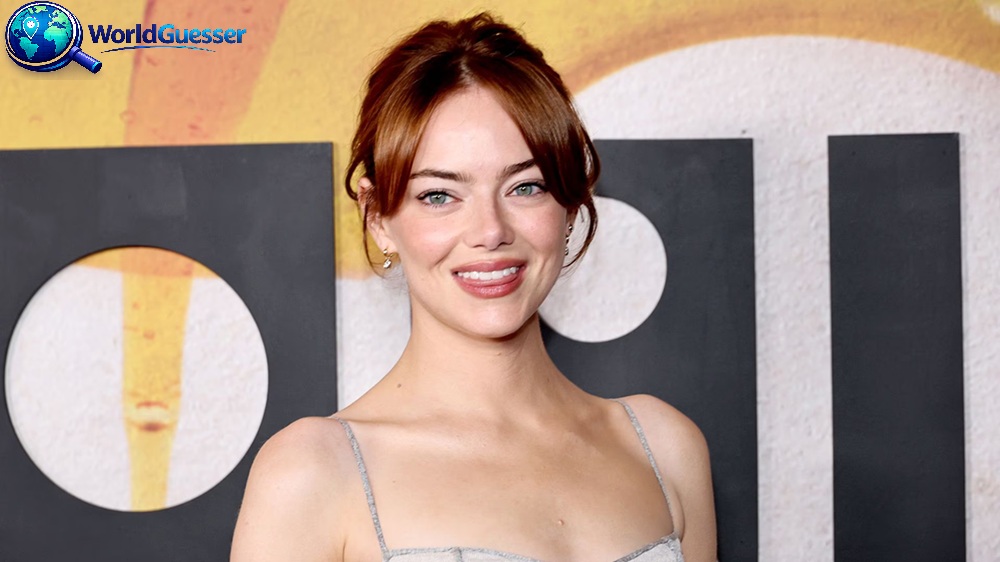
Emma Stone is an American actress and film producer born Emily Jean Stone on November 6, 1988, in Scottsdale, Arizona. She is one of the most decorated performers of her generation — a two-time Academy Award winner with seven total Oscar nominations who has built her career not on the back of franchise roles or traditional star vehicles, but through a consistent series of bold, director-driven choices. Her natural wit, distinctive husky voice, and ability to move between broad comedy and unguarded dramatic performance have made her a collaborator of choice for some of contemporary cinema’s most demanding filmmakers.
By 2017, she had become the world’s highest-paid actress and was named by Time magazine as one of the 100 most influential people in the world. Her second Oscar win for Poor Things in 2024, followed by further nominations for Bugonia in 2026, confirmed that rather than settling into the safer territory that often follows major career peaks, Emma Stone has continued to take the kinds of risks that define lasting careers rather than momentary ones.
| Detail | Information |
|---|---|
| Full Name | Emily Jean Stone |
| Born | November 6, 1988, Scottsdale, Arizona, USA |
| Nationality | American |
| Occupation | Actress, film producer |
| Years Active | 2004–present |
| Notable Films | Easy A (2010), La La Land (2016), The Favourite (2018), Poor Things (2023), Bugonia (2025) |
| Academy Awards | 2 wins (La La Land, Poor Things); 7 nominations total |
| Other Awards | 2 BAFTAs, 2 Golden Globes, Volpi Cup |
| Spouse | Dave McCary (married September 2020) |
| Children | Louise Jean McCary (born March 2021) |
| Production Company | Fruit Tree (founded 2020 with Dave McCary) |
The PowerPoint That Started It All
Stone grew up in Scottsdale, Arizona, the daughter of Jeffrey Charles Stone, founder and CEO of a contracting company, and Krista Jean Stone, a homemaker. She has a younger brother, Spencer. Her ancestry is Swedish, German, and British Isles through her father’s side — the family surname was anglicised when her Swedish grandfather immigrated through Ellis Island.
As a child she struggled with severe anxiety and panic attacks that affected her social development. Theatre, she has said, became the mechanism through which she managed them. She began performing at age eleven with the Valley Youth Theatre in Phoenix, where her debut was a production of The Wind in the Willows. Over the following years she appeared in sixteen productions for the company, including Cinderella, Alice in Wonderland, and Joseph and the Amazing Technicolor Dreamcoat, and performed with its improvisational comedy group.
At fifteen, having attended Xavier College Preparatory for only one semester, she decided to pursue acting professionally and needed to persuade her parents to let her leave school and move to Los Angeles. Her method — now a regularly retold piece of Hollywood lore — was a PowerPoint presentation titled “Project Hollywood,” set to Madonna’s song “Hollywood.” It worked. In January 2004, Stone and her mother moved into a Los Angeles apartment where Stone completed her schooling online between auditions. Between callbacks, she worked part-time at a dog-treat bakery. When she registered with the Screen Actors Guild at sixteen, “Emily Stone” was already taken; she briefly used “Riley Stone” before settling on “Emma,” chosen in tribute to Emma Bunton of the Spice Girls.
Television and the Road to Superbad
Stone’s television debut came in 2004 with In Search of the New Partridge Family, a VH1 reality competition searching for cast members for a proposed reboot. The resulting pilot was never picked up. Guest roles on Medium (2005) and Malcolm in the Middle (2006) followed, along with an appearance in Louis C.K.’s HBO series Lucky Louie (2006). She auditioned relentlessly — her own account is that she went up for every single Disney Channel show and every sitcom daughter role available — and was rejected for all of them.
Her film debut came in 2007 with a supporting role in Superbad, the Judd Apatow-produced teen comedy starring Jonah Hill and Michael Cera. Playing the cool girl Jules opposite Hill, Stone made a strong impression with a relatively small role and won the Young Hollywood Award for Breakthrough Performance. The role did not make her a star, but it put her in the conversation. A brief run on the short-lived Fox action series Drive followed the same year.
Breakthrough: Easy A and the Comedy Years
Easy A (2010) was the film that defined Stone’s early career identity. Playing Olive Penderghast, a sharp-witted high school student whose reputation unravels after a rumoured sexual encounter, Stone carried a film built almost entirely around her charisma, comic timing, and ability to deliver ironic dialogue with the warmth of someone who genuinely means it. The film grossed $75 million against an $8 million budget. It earned her a BAFTA Rising Star Award nomination and a Golden Globe nomination for Best Actress in a Musical or Comedy — the first significant awards recognition of her career.
The following year brought two contrasting films that demonstrated early range. Crazy, Stupid, Love (2011) paired her opposite Ryan Gosling in the romantic comedy that would become the foundation of one of cinema’s most reliable screen partnerships; and The Help (2011), set in 1960s Mississippi, gave her the period dramatic work that earned the entire ensemble a SAG Award for Outstanding Cast. Kirk Honeycutt of the Hollywood Reporter described her at the time as one of the best young actresses working.
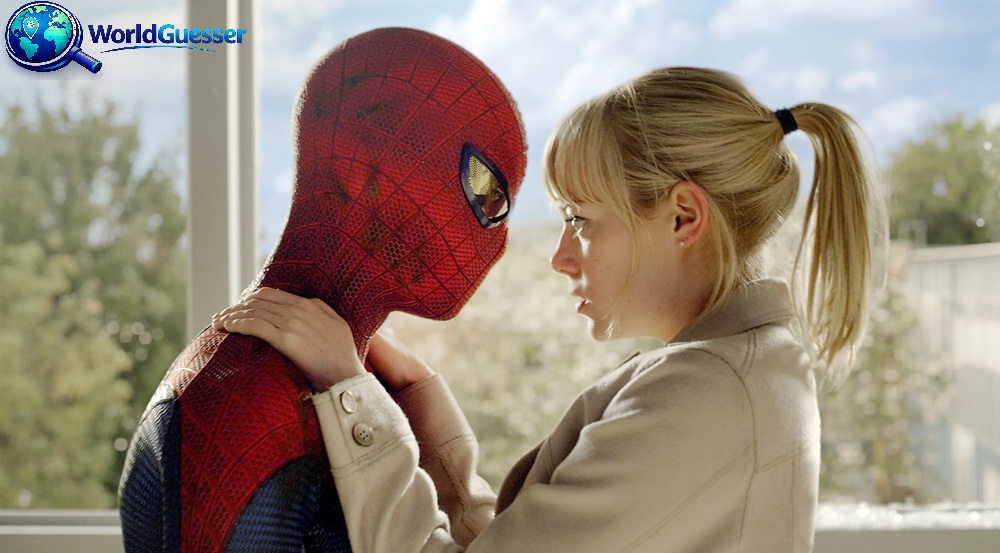
The Marvel interlude — playing Gwen Stacy in Marc Webb’s The Amazing Spider-Man (2012) and its sequel (2014) — brought her global recognition at scale and a relationship with co-star Andrew Garfield that lasted four years before ending in 2015. The Spider-Man films were, by general consensus including Stone’s own, the least personally interesting work of her career, but they gave her the platform that made everything after them possible.
Key Films and Awards at a Glance
| Film | Year | Role | Award |
|---|---|---|---|
| Easy A | 2010 | Olive Penderghast | Golden Globe nomination |
| Birdman | 2014 | Sam Thomson | Oscar nomination (Supporting) |
| La La Land | 2016 | Mia Dolan | Oscar win (Best Actress), Golden Globe win |
| Battle of the Sexes | 2017 | Billie Jean King | — |
| The Favourite | 2018 | Abigail Masham | Oscar nomination (Supporting) |
| Poor Things | 2023 | Bella Baxter | Oscar win (Best Actress), BAFTA win |
| Kinds of Kindness | 2024 | Multiple roles | — |
| Bugonia | 2025 | Michelle Fuller | Oscar nomination (Best Actress + Best Picture) |
La La Land and the First Oscar
La La Land (2016) arrived via an unexpected route. While performing on Broadway in a revival of Cabaret in 2015, Stone met director Damien Chazelle, who was sufficiently impressed by her stage work to cast her as Mia Dolan, an aspiring actress navigating Los Angeles alongside Ryan Gosling’s jazz musician. The film served as the opening night selection at the 2016 Venice Film Festival, where it generated rapturous reviews and earned Stone the Volpi Cup for Best Actress. It went on to gross over $440 million worldwide against a $30 million budget and became the most commercially successful musical drama in decades.
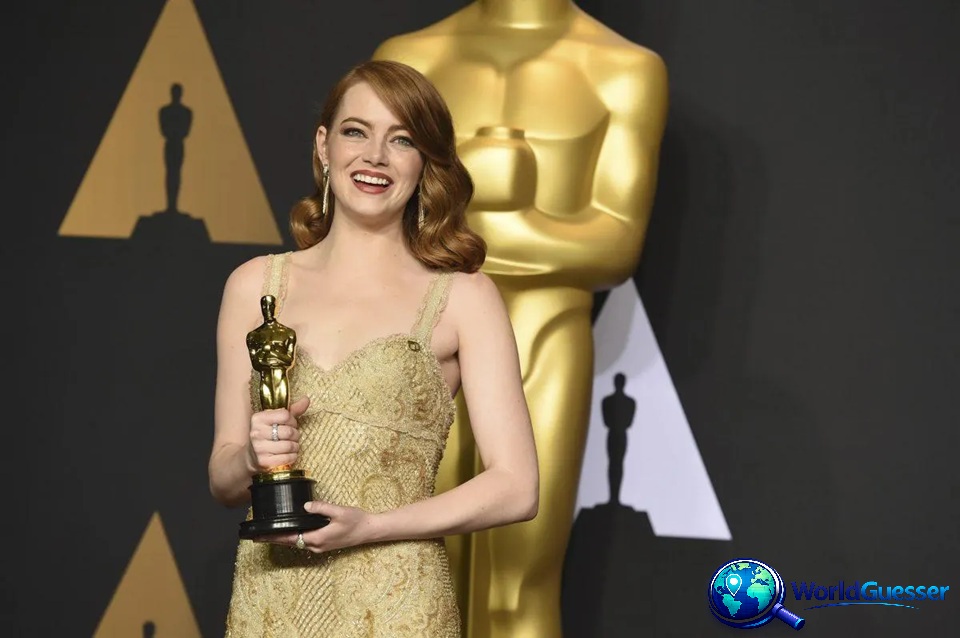
At the 89th Academy Awards, Stone won Best Actress — defeating Isabelle Huppert, Natalie Portman, Ruth Negga, and Meryl Streep. The ceremony itself became one of the most discussed in Oscar history when La La Land was incorrectly announced as Best Picture winner before Moonlight was confirmed as the actual recipient. Stone was already backstage when the error unfolded and has since spoken about the surreal quality of the evening’s final half hour.
The Favourite and the Lanthimos Chapter
Birdman (2014) had given Stone her first Oscar nomination in the supporting actress category, and Battle of the Sexes (2017) — in which she played tennis legend Billie Jean King with close physical and psychological attention — earned strong reviews without translating to major awards traction. But it was The Favourite (2018), directed by Yorgos Lanthimos, that opened the creative partnership that would come to define the second phase of her career.
Playing Abigail Masham, a scheming young woman who insinuates herself into the court of Queen Anne while competing for power against Olivia Colman and Rachel Weisz, Stone demonstrated a controlled menace that was new in her filmography. The performance earned her second Oscar nomination, this time in the supporting actress category. More significantly, it established a working relationship with Lanthimos built on a shared appetite for material that refuses to resolve comfortably — for stories in which the usual signals of sympathy and judgement are deliberately withheld.
Between The Favourite and Poor Things, Stone executive produced and starred in Cruella (2021), a Disney live-action origin story for the 101 Dalmatians villain that gave her a different kind of showcase — broad, theatrical, costumed excess — and performed well commercially. She also led the Netflix miniseries Maniac (2018) opposite Jonah Hill and The Curse (2023), a dark comedy series with Nathan Fielder, both of which reinforced her credentials as a performer willing to work in sustained, unconventional registers that most film stars avoid.
Poor Things and the Second Oscar
Poor Things (2023) represents the most fully realised version of the Lanthimos-Stone collaboration. As Bella Baxter — a Victorian woman crudely resurrected with the brain of her unborn child, who discovers the world without any internalised constraint — Stone gave a performance of extraordinary physical and emotional commitment. She worked as both actress and producer on the film, and the dual investment shows: every choice in Bella’s arc, from the lurching locomotion of early scenes through to the philosophical poise of the finale, feels like the product of someone who had spent sustained time thinking about what the character’s freedom actually means.
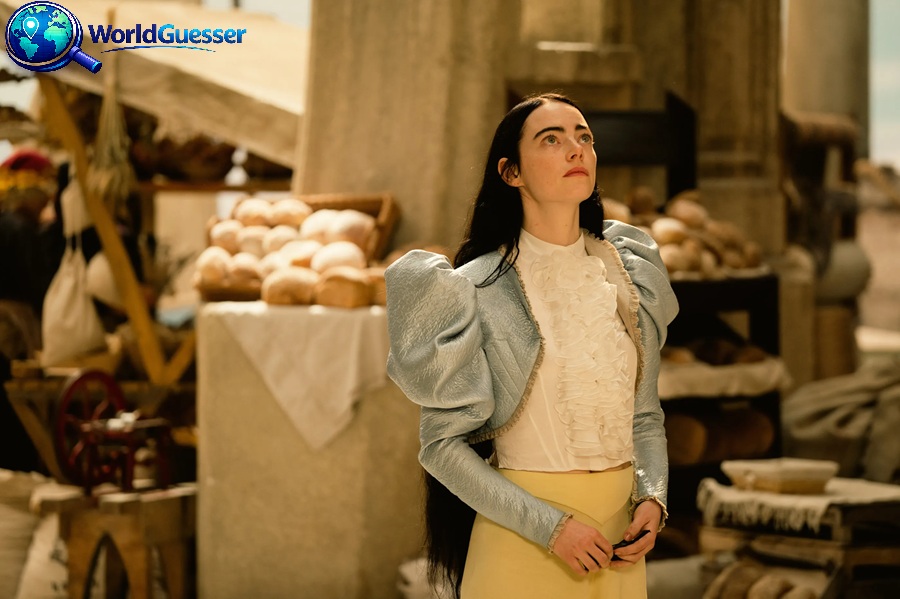
The film won the Golden Lion at Venice and eleven Academy Award nominations. At the 96th ceremony, Stone won her second Best Actress Oscar — also picking up a Best Picture nomination as a producer, making her the first woman to receive dual nominations as actress and producer in the same film. In her acceptance speech, she thanked her daughter Louise, who was three days away from turning three, describing her as someone who had turned their lives technicolor.
Bugonia and Record-Breaking Oscar History
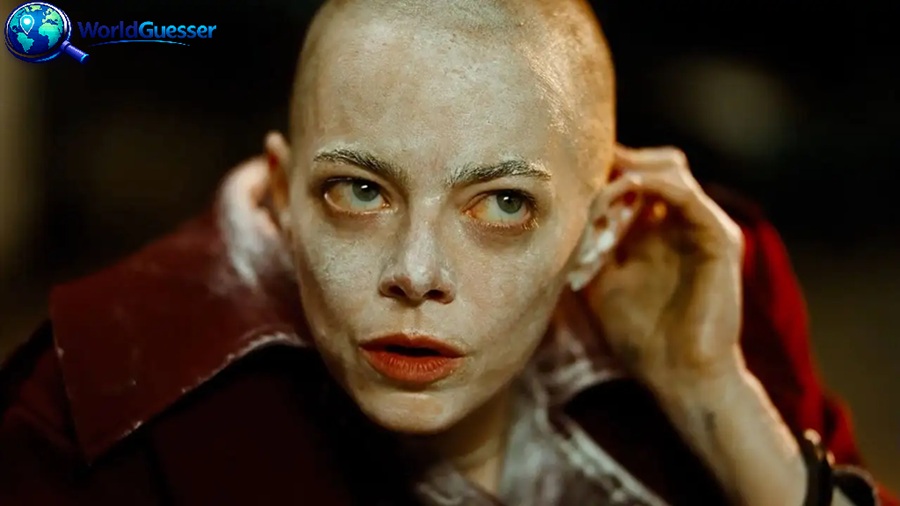
Kinds of Kindness (2024), a Lanthimos triptych written with Efthimis Filippou, saw Stone play multiple characters across three loosely connected stories. It was divisive, austere, and commercially modest — exactly the kind of film that most two-time Oscar winners do not make immediately after their second win. It was followed by Bugonia (2025), based on the 2003 South Korean cult film Save the Green Planet!, in which Stone plays Michelle Fuller, a pharmaceutical CEO kidnapped by a conspiracy theorist convinced she is an alien. Stone shaved her head for the role and, in the film’s final revelation, turns out to be exactly what her kidnapper suspected.
The film earned four Oscar nominations for the 98th Academy Awards ceremony, including Best Picture and Best Actress. Stone became the second-youngest person in Oscar history to accumulate seven total nominations — only Walt Disney was younger when he reached that tally in 1936. Among women, she surpassed Meryl Streep, who was 38 at her seventh nomination in 1988; Stone was 37. She also became the first woman to receive dual nominations as actress and producer across two separate films, having done so previously with Poor Things.
Personal Life and Fruit Tree
Stone met writer and director Dave McCary in December 2016 when she returned to host Saturday Night Live for the third time. McCary, then a segment director on the show, wrote and directed the sketch she performed in. They began dating in 2017, became engaged at the end of 2019, and married in a private ceremony in September 2020 during the COVID-19 pandemic — a ceremony so discreet that, according to reports, the location was not listed on the invitations. Their daughter, Louise Jean McCary, was born on March 13, 2021, named after Stone’s grandmother Jean Louise Morgan. Stone and her mother Krista both share the middle name Jean as a family thread through three generations.
Stone has been consistently private about her personal life, and that quality of discretion extends to how she speaks about parenthood. She told Vogue in September 2025 that becoming a mother had streamlined her approach to choosing roles — that it had simplified what had once felt complicated, and that the question of how long a job would keep her away from Louise now featured in every professional decision. She and McCary also co-founded the production company Fruit Tree in 2020, which has produced When You Finish Saving the World, Problemista, and A Real Pain, establishing itself as a vehicle for independent filmmakers rather than a vanity operation.
Stone’s distinctive husky voice — noted across nearly every profile written about her — has an origin in childhood illness. Baby colic that lasted six months caused chronic crying that developed into nodules on her vocal cords, leaving calluses that have remained throughout her adult life.
An Actress Who Keeps Refusing the Easy Choice
The shape of Emma Stone’s career, viewed from the outside, looks like a series of well-managed escalations from teen comedy to prestige drama to global stardom. From the inside, it reads differently: as a consistent pattern of choosing the uncomfortable option, the director whose methods are unconventional, the role that has no built-in audience goodwill. The anxiety that drove her into theatre as a child has, over two decades of professional acting, been converted into something more useful — a restlessness that prevents consolidation and keeps her in territory where the outcome is genuinely uncertain. With two Oscars already won and a third nomination still live at the 98th ceremony, she remains, at 37, an actress whose most interesting work may still be ahead of her.