
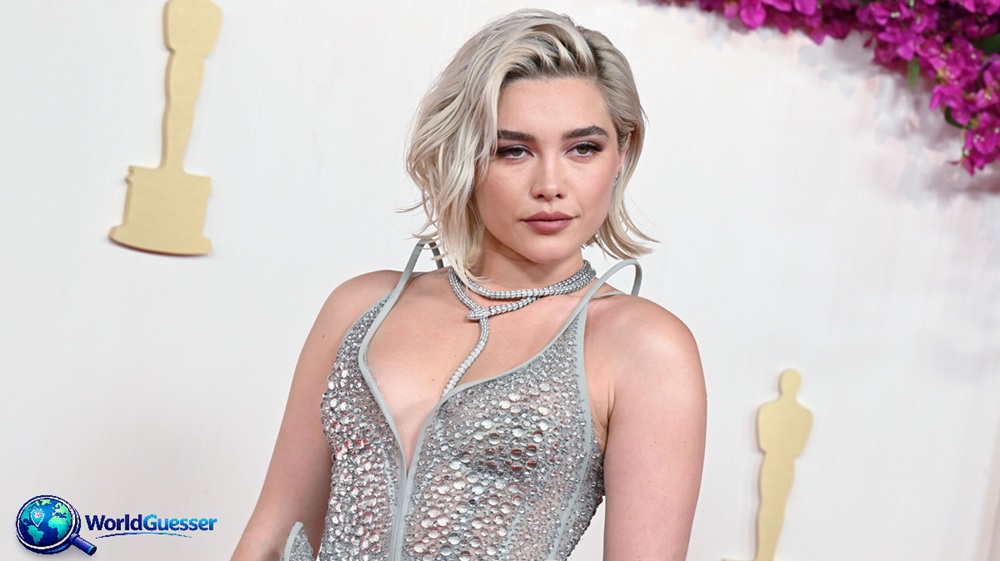
At the age of six, Florence Pugh played the Virgin Mary in a school nativity play at Sotogrande, Spain — and decided, on the spot, to perform the role in a broad northern English accent while improvising complaints about varicose veins. The audience erupted. The response clarified something she had not yet had language for. “It was the first time I knew the power of being on stage,” she said years later. “I remember thinking, ‘Oh God, they’re waiting for me, they’re listening to everything I say, and I have complete control.'”
| Quick Facts | Details |
|---|---|
| Full Name | Florence Rose Pugh |
| Pronunciation | “Pyoo” — rhymes with “few” |
| Date of Birth | January 3, 1996 |
| Birthplace | Oxford, England |
| Age (2026) | 30 years old |
| Height | 5 ft 3¾ in (1.62 m) |
| Father | Clinton Pugh — restaurateur |
| Mother | Deborah Pugh — dancer and dance teacher |
| Siblings | Toby Sebastian (actor/musician; older brother); Arabella Gibbins (actress; older sister); Rafaela “Raffie” Pugh (younger sister) |
| Childhood condition | Tracheomalacia — partially collapsed trachea; frequent hospitalisations; caused distinctive deep raspy voice |
| Spain years | Ages 3–6 — Sotogrande, Andalusia, near Gibraltar |
| Schools | Wychwood School, Oxford; St Edward’s School, Oxford |
| YouTube | Flossie Rose (2013–2016) — guitar and vocals cover songs |
| Film debut | The Falling (2014) — first professional audition; opposite Maisie Williams |
| Breakthrough (UK) | Lady Macbeth (2016) — BIFA Best Actress; BAFTA Rising Star nomination 2018 |
| Breakthrough (global) | Fighting with My Family, Midsommar, Little Women (all 2019) |
| Oscar nomination | Best Supporting Actress — Amy March, Little Women (2019) |
| MCU role | Yelena Belova — Black Widow (2021), Hawkeye (2021), Thunderbolts* (2025) |
| Highest-grossing film | Oppenheimer (2023) — $967 million; also Dune: Part Two (2024) — $711 million |
| Three Best Picture nominees | Little Women (2019), Oppenheimer (2023), Dune: Part Two (2024) |
| Relationship | Zach Braff (2019–2022; 21-year age gap); currently private |
| Notable controversy | Valentino sheer pink gown, 2022 — responded to body critics publicly |
| Directors (female) | Carol Morley, Greta Gerwig, Cate Shortland, Olivia Wilde, Jessica Swale |
| Net Worth (est. 2026) | $8 million – $12 million |
The word is precise. Control — not approval, not applause, but control — is the quality that Florence Pugh has pursued with consistent focus across every significant decision of her career since that nativity play: the roles she chooses, the directors she works with, the public statements she makes, the way she handles controversy and criticism. She is one of the most decorated young actresses in contemporary cinema — Academy Award nomination, BIFA win, three BAFTA nominations, a Cannes Trophée Chopard, appearances in three separate Best Picture nominees — and she achieved all of it before her thirtieth birthday, with no formal drama school training, from a first professional audition that led directly to a screen debut.
The voice that helped her get there — the deep, raspy, immediately distinctive voice that separates her from most of her generational peers and gives every performance an additional register of authority — is itself the product of a childhood medical condition that might, in a different person’s story, have been a limitation. In Florence Pugh’s story, it is the origin of everything.
Oxford, Tracheomalacia, and the Voice That Made Her
Florence Rose Pugh was born on January 3, 1996, in Oxford, England — the city that would remain the geographic anchor of her identity and education through her adolescence, and whose specific character (university town, arts culture, proximity to the English countryside that shapes so much of British independent filmmaking) contributed to the sensibility that her early career consistently reflected.
Her father, Clinton Pugh, is a restaurateur. Her mother, Deborah Pugh, is a dancer and dance teacher — a professional background whose influence on Florence’s physical expressiveness and movement intelligence is evident across her screen performances in ways that formal actor training does not always produce. Her three siblings are all creatively oriented: her older brother Toby Sebastian is an actor and musician who, like Florence’s Little Women co-star Saoirse Ronan’s fictional experience, dropped the family surname for professional purposes — performing as Toby Sebastian rather than Toby Pugh; her older sister Arabella Gibbins is an actress; and her younger sister Rafaela “Raffie” Pugh is also an actor. The family is, in the most straightforward sense, a creative household — one in which artistic expression was the ambient condition rather than the exceptional aspiration.
Shortly after Florence’s birth, she developed tracheomalacia — a condition in which the trachea (windpipe) is insufficiently rigid and partially collapses during normal breathing, restricting airflow. The condition is common in infants and often resolves as the cartilage of the trachea strengthens during development; in Florence’s case, it was persistent enough to require hospitalisation on multiple occasions throughout her early childhood, and severe enough that her family took a significant practical decision to address it.
A tube was inserted in her trachea to facilitate normal breathing. The medical intervention resolved the immediate crisis — she did not continue to experience the acute breathing difficulties that had characterised her earliest years — but left a permanent physical legacy: the distinctive deep, raspy, husky voice that has become one of the most immediately recognisable vocal signatures in contemporary cinema. She has described it herself with characteristic wit: “It’s the reason I have a deep voice and why I sound like a goose when I laugh.” The condition is, she has noted, the explanation for a voice that creates a curious visual dissonance — a round, youthful face producing a sound that belongs to someone considerably older and more weathered. That dissonance is, in performance terms, an asset of the first order.
Sotogrande, Spain: The Mediterranean Years (Ages 3–6)
When Florence was three years old, the family relocated to Sotogrande — a coastal community in Andalusia, in the southernmost corner of Spain, near the border with Gibraltar and within sight of the Strait separating Europe from Africa. The move was made specifically for Florence’s health: the warmer, drier Mediterranean climate was considered more conducive to the recovery of a child with respiratory difficulties than the damp, cold winters of Oxfordshire.
They stayed for three years. Florence returned to Oxford at age six with her condition essentially unchanged — the tracheomalacia had not resolved as hoped — but with a set of formative experiences whose influence on her sensibility is worth noting. The Sotogrande years placed her in a multilingual, multicultural environment during the developmental years when linguistic and cultural impressions are most deeply absorbed; they exposed her to a physical and social landscape entirely different from the English countryside; and they concluded with the nativity play performance — in Spain, before a Spanish and international audience — that gave her the first clear signal of what she was going to do with her life.
The family returned to the converted barn in Shrivenham, Oxfordshire, that had been their base before the Spanish detour. Florence attended Wychwood School in Oxford — a girls’ school — and then St Edward’s School in Oxford, a private co-educational school whose academic curriculum was strong but whose attitude toward acting she later described with barely disguised irritation. The school, she noted, was not particularly supportive of the ambition she was already clearly developing. She did not pursue formal drama school training after leaving — getting her agent directly from her first professional film rather than through the institutional pathway that most British actors of her generation followed.
Between school years, she began performing on YouTube under the username Flossie Rose — posting cover songs accompanied by her own guitar playing from 2013 to 2016. The videos attracted a genuine following and documented a musical competence — she also plays piano and writes her own songs — that is entirely separate from her screen career but reflects the same performance instinct. She also ran a cooking channel, Cooking With Flo, whose domestic warmth contrasts entertainingly with the psychological intensity of most of her screen choices.
The Falling (2014): First Audition, First Film, First Agent
The audition for Carol Morley’s The Falling — a mysterious, atmospheric film set in a 1960s English girls’ school, involving a fainting epidemic — was Florence Pugh’s first professional audition. She was seventeen years old. She got the role opposite Maisie Williams (then known primarily as Arya Stark from Game of Thrones). The film premiered at the London Film Festival, where it received a nomination for Best British Newcomer in Florence’s direction.
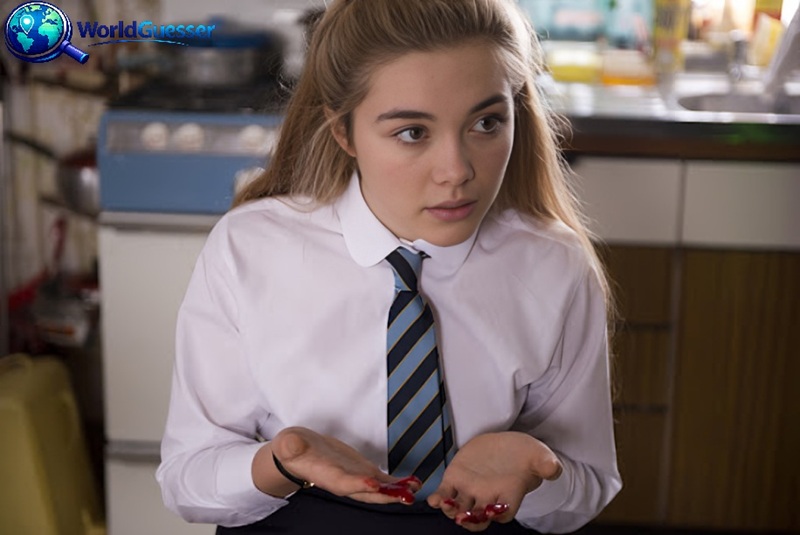
Directly from that film, she got her agent. She did not apply to drama school. The standard British acting career pathway — RADA, LAMDA, or Guildhall; regional theatre; television guest roles; eventual film work — did not apply to Florence Pugh because she bypassed it at the first possible opportunity and never looked back.
The experience on The Falling also established what would become one of the most consistent features of Florence Pugh’s career: the choice to work with female directors. Carol Morley was the first; Greta Gerwig, Cate Shortland, Olivia Wilde, and Jessica Swale would follow. The pattern is not coincidental or merely biographical — it reflects a conscious artistic preference for the specific quality of collaborative environment that these directors have consistently provided.
The film did not make her famous. It made her employable — which, at seventeen, with no drama school and no prior professional credits, was the foundation she needed.
Lady Macbeth (2016): The Performance That Announced Her
Two years after The Falling, William Oldroyd’s Lady Macbeth — adapted from Nikolai Leskov’s 1865 Russian novella Lady Macbeth of the Mtsensk District, transplanted to Victorian rural England — gave Florence Pugh her first role of genuine size and the first performance that demanded critics take her seriously as a talent of the first order.
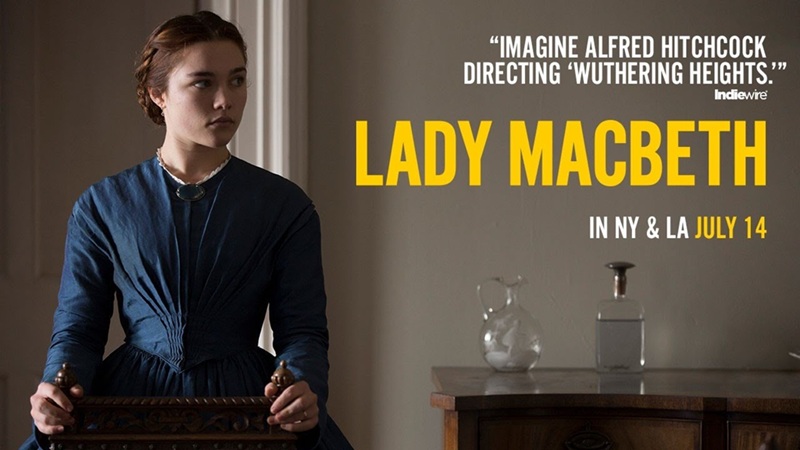
She played Katherine — a young woman sold into a joyless marriage to a man twice her age, who finds first freedom and then violence through an affair with a farmhand. The role required her to carry almost every scene in the film, to portray a character whose moral descent is progressive and whose motivations are simultaneously sympathetic and disturbing, and to do so in a period costume drama whose visual and tonal register demanded the specific kind of controlled, physically precise performance that the genre requires.
She won the British Independent Film Award for Best Performance by an Actress in a British Independent Film. She was nominated for the BAFTA Rising Star Award in 2018. The film, and her performance in it, became the specific credential that caused Marvel Studios — casting Yelena Belova for Black Widow in 2019 — to return to her after initially overlooking her, having seen Fighting with My Family and subsequently reviewed her earlier work.
Florence has described Lady Macbeth as the production that revived her interest in cinema after a period of disillusionment — a telling admission that suggests the two years between The Falling and Lady Macbeth included professional experiences that tested her commitment. The specific experiences she was referring to were, she later explained, ones that made her feel undervalued or creatively constrained. Lady Macbeth — a film that gave her total creative investment and absolute centrality — resolved that doubt.
2019: The Year That Changed Everything
The three films that Florence Pugh released in 2019 constitute one of the most remarkable single-year breakthroughs in recent acting history — not because any one of them alone would have been extraordinary, but because the combination demonstrated a range that most actors spend a decade attempting to prove and that she delivered in twelve months.
Fighting with My Family (directed by Stephen Merchant; released February 2019) cast her as Paige — Saraya-Jade Bevis, the real-life professional wrestler who became WWE Divas Champion. The role required genuine physical preparation; she trained with professional wrestler Tessa Blanchard as a talent double and developed enough wrestling capability to perform significant portions of the training sequences herself. She dyed her hair jet black. She adopted a Midlands accent. Critics, including Geoffrey Macnab of The Independent, called her portrayal completely convincing. It was also, notably, a genuinely funny performance — a dimension of her capability that her more acclaimed dramatic work sometimes obscures.
Midsommar (directed by Ari Aster; released July 2019) placed her at the centre of one of the most emotionally demanding horror films of the decade — as Dani Ardor, an American graduate student whose devastating grief following her sister’s suicide makes her vulnerable to the increasingly nightmarish folk rituals of a Swedish commune. The role required Florence to spend much of the film in states of active, visible emotional crisis — crying, screaming, dissociating — performed for a camera that did not cut away and within a production environment that Ari Aster deliberately kept immersive. She has spoken directly about the emotional cost of the filming: she experienced depression for approximately six months after completing it. The performance is, by critical consensus, the film’s central achievement — David Edelstein of Vulture called it “amazingly vivid.”
She was simultaneously filming Little Women (directed by Greta Gerwig) — overlapping so directly that she was unable to participate in the two-week rehearsal period that her co-stars (Saoirse Ronan, Emma Watson, Eliza Scanlen) underwent together. She arrived at the Little Women set already in a different emotional register from the rest of the ensemble, playing Amy March — the younger, pricklier, more pragmatic Alcott sister — as an outsider to the group dynamics that the other three had established. Gerwig, recognising what the circumstance had produced, leaned into it: Amy’s status as the odd sister out, never quite belonging in the way her sisters do, was deepened by the unintentional separation Florence’s Midsommar schedule had created.
The Academy Award nomination for Best Supporting Actress that followed is the biographical headline. More interesting is the specific monologue about marriage as an economic transaction that Florence delivered as Amy — improvised on set, with Meryl Streep’s encouragement, on the day of filming. It became the performance’s most discussed moment and the clearest illustration of what Florence Pugh brings to a set: the willingness, the speed, and the intelligence to find something in the moment that the script had not placed there.
The MCU: Yelena Belova and the Franchise Balance
Florence Pugh joined the Marvel Cinematic Universe as Yelena Belova — the adopted sister and fellow Black Widow of Scarlett Johansson’s Natasha Romanoff — in Cate Shortland’s Black Widow (2021). The film was a COVID-delayed release that finally arrived simultaneously in cinemas and on Disney+ in July 2021; the simultaneous streaming release became the subject of a lawsuit from Scarlett Johansson against Disney, which was settled privately.
Florence’s performance as Yelena — sardonic, physically formidable, emotionally unexpectedly affecting in the film’s second half — was, by critical consensus, the film’s strongest element. She reprised the role in three episodes of the Disney+ series Hawkeye (2021), providing a post-credits sting for Black Widow‘s aftermath narrative, and returned for Thunderbolts* (2025) — the MCU ensemble film in which Yelena takes a central position alongside a team of morally compromised characters.
Her management of the franchise relationship is worth noting. She has not allowed the MCU work to define or dominate her profile — maintaining an equally prominent simultaneous presence in prestige independent cinema that keeps her actor identity distinct from her franchise character. The year Black Widow released, she was also completing Don’t Worry Darling and The Wonder. The year Thunderbolts* released, she had already delivered We Live in Time and Dune: Part Two.
Oppenheimer, Dune: Part Two, and the Prestige Chapter
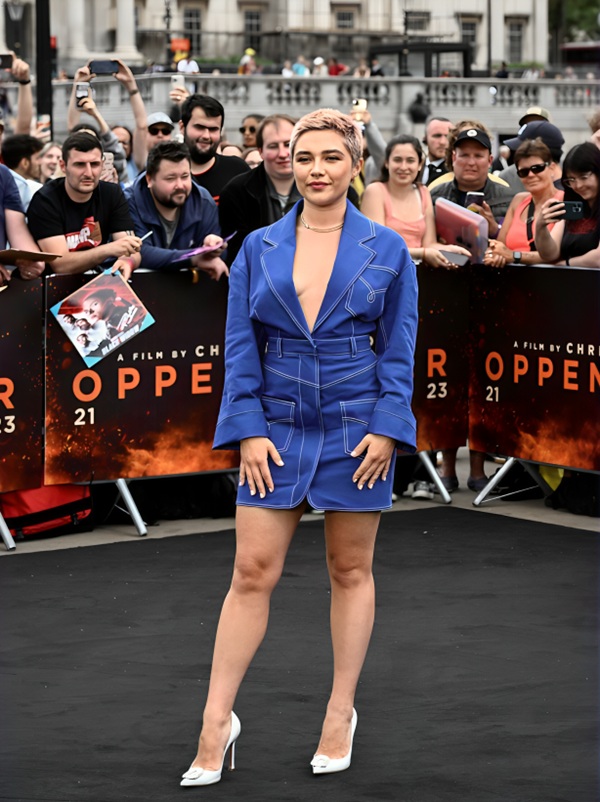
The two highest-grossing films of Florence Pugh’s career to date are both prestige productions that cast her in specific supporting roles of considerable importance. In Christopher Nolan’s Oppenheimer (2023) — the $967 million biographical epic about the father of the atomic bomb — she played Jean Tatlock, the Communist Party member and psychiatrist whose relationship with J. Robert Oppenheimer (Cillian Murphy) provides the film’s most intimate and politically charged personal dimension. The film won the Academy Award for Best Picture.
In Denis Villeneuve’s Dune: Part Two (2024) — the $711 million adaptation of Frank Herbert’s science fiction epic — she played Princess Irulan, the Emperor’s daughter whose political machinations frame the film’s conclusion. The role is precisely calibrated: present and significant without overwhelming the narrative’s central arc, requiring the specific quality of dignified authority that Florence’s voice — that deep, certain, unhurried voice — delivers more naturally than almost anyone of her age in contemporary cinema.
She has now appeared in three separate films nominated for the Academy Award for Best Picture — Little Women, Oppenheimer, and Dune: Part Two — a distinction that, at thirty years old, places her in company that most actors never reach.
Personal Life: Zach Braff, the Valentino Dress, and the Gaza Petition
Florence Pugh and Zach Braff — the Scrubs actor and director, 21 years her senior — began their relationship in 2019 and made it public in April 2020. The 21-year age gap attracted immediate and sustained public commentary, most of it negative from the perspective of online observers who considered the disparity significant. Florence’s response was direct and consistent: she declined to accept the premise that the age gap was anyone else’s business, addressed it specifically in an Instagram post in August 2020 noting that she had been aware of the age gap since the relationship began and did not require commentary on it, and continued the relationship on exactly the terms she and Braff had established between themselves. They separated in 2022.
In June 2022, she attended the Valentino Couture show in Rome wearing a sheer pale pink tulle gown beneath which her breasts were visible. The social media response included the body-shaming commentary that such choices reliably produce. Her response — posted publicly, addressed to her detractors directly — included the phrase “Grow up” and a longer articulation of her frustration with the specific form of commentary that treats women’s bodies as public property subject to public approval. The response was widely covered and widely applauded.
In September 2025, she attended a fundraiser in London in support of Palestinian civilians — an act of political commitment that she has combined with signing a petition to the British government regarding the humanitarian situation in Gaza. Her political engagement is consistent with the general pattern of her public persona: direct, specific, willing to attach her name and presence to positions that attract disagreement.
Net Worth: The Honest Picture at 30
| Income Source | Estimated Contribution |
|---|---|
| Lady Macbeth, The Falling, early indie films | Modest; scale of British independent cinema |
| Fighting with My Family, Midsommar, Little Women (2019) | Growing significantly |
| Black Widow MCU debut (2021) | Hundreds of thousands (reported) |
| Don’t Worry Darling, The Wonder (2022) | Mid-level studio fees |
| Oppenheimer (2023) — supporting role | $1–2M (estimated) |
| Dune: Part Two (2024) — supporting role | $1–2M (estimated) |
| Thunderbolts* MCU (2025) | Est. $2–3M |
| We Live in Time (2024) | Independent scale |
| Endorsements and brand partnerships | Additional |
| Estimated Total Net Worth (2026) | $8 million – $12 million |
The net worth reflects a career that is, by any measure, still in its early chapter. Florence Pugh turned thirty in January 2026. The trajectory of her earning power — moving from independent British cinema into major studio franchise roles and prestige blockbusters simultaneously — suggests the $8–$12 million figure is a foundation rather than a ceiling.
Conclusion
Florence Pugh was born in Oxford on January 3, 1996, with a collapsed windpipe that hospitalised her repeatedly, sent her family to Spain for three years, and gave her the deep, raspy voice that makes every word she says on screen land with a weight that most actresses spend careers trying to manufacture. She played the Virgin Mary at six with a northern accent and improvised varicose veins. She got her first professional role on her first professional audition at seventeen. She had no drama school. By twenty-three she had an Academy Award nomination. By thirty she had appeared in three Best Picture nominees, joined one of the largest film franchises in history, and built a public persona defined by the same quality she identified in herself at that nativity play in Spain: complete control.
The voice that makes her sound like a goose when she laughs. The brain that improvised Amy March’s most famous monologue on the day of filming. The spine that told the internet to grow up. These are not separate things. They are the same person, doing what she decided at six years old that she was going to do.