
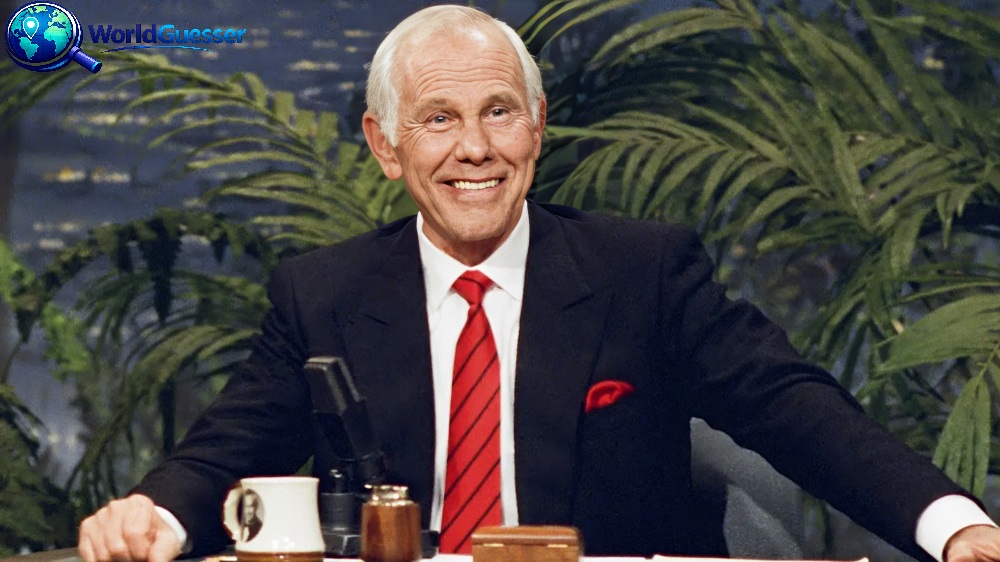
Johnny Carson was an American television host, comedian, writer, and producer whose thirty-year tenure as host of The Tonight Show Starring Johnny Carson made him the most watched, most trusted, and most influential entertainer in the history of American late-night television. Born John William Carson on October 23, 1925, in Corning, Iowa, and raised in Norfolk, Nebraska, he came from the heartland of America and carried that quality — a fundamental decency, a lack of pretension, an instinctive respect for his audience — through five decades of one of the most sustained and celebrated careers in entertainment history. He retired in 1992, died in 2005, and has not been replaced. The desk he occupied for thirty years remains, in the cultural imagination, uniquely his.
| Quick Facts | Details |
|---|---|
| Full Name | John William Carson |
| Date of Birth | October 23, 1925 |
| Date of Death | January 23, 2005 (age 79) |
| Birthplace | Corning, Iowa, USA |
| Raised In | Norfolk, Nebraska |
| Education | University of Nebraska — B.A. (1949) |
| Military Service | U.S. Navy, World War II (1943–1946) |
| Known As | “The King of Late Night” |
| Signature Show | The Tonight Show Starring Johnny Carson (NBC, 1962–1992) |
| Tonight Show Run | 29 years, 7 months, 21 days |
| Sidekick | Ed McMahon |
| Bandleader | Doc Severinsen |
| Emmy Awards | 6 Primetime Emmy Awards |
| Other Honours | Peabody Award (1985); Presidential Medal of Freedom (1992); Kennedy Center Honour (1993); TV Academy Hall of Fame (1987) |
| Marriages | Jody Morrill Wolcott (1949–1963); Joanne Copeland (1963–1972); Joanna Holland (1972–1983); Alexis Maas (1987–2005) |
| Children | Christopher, Ricky (died 1991), Cory Carson |
| Estate | ~$300 million; $156 million donated to Johnny Carson Foundation |
| Cause of Death | Emphysema |
What made Johnny Carson remarkable was not merely his wit, though his wit was extraordinary. It was the combination of qualities that almost never coexist in a single person: the lightning-quick intelligence of a stand-up comedian, the warmth and patience of a great interviewer, the discipline of a craftsman who showed up every weeknight for three decades, and the self-awareness of a man who understood precisely what he was doing and why it worked. He was, as Walter Cronkite said, “the most durable performer in the whole history of television.” He was also, as those who knew him privately understood, considerably more complicated than the man America saw each evening at 11:30.
Corning, Iowa to Norfolk, Nebraska: A Midwestern Foundation
John William Carson was born on October 23, 1925, in Corning, Iowa, to Homer Carson, a power company manager, and his wife Ruth. When Carson was eight years old, his father relocated the family to Norfolk, Nebraska — a small city in the northeastern part of the state — and it was there that the defining elements of Carson’s character and comedic sensibility were formed.
Norfolk was not a glamorous place, and Carson’s childhood was not a glamorous one. But it was formative in ways that shaped everything that came after. At the age of twelve, he discovered a book on magic tricks and was immediately captivated. He sent away for a magician’s kit through the mail — the kind of impulsive, self-directed act of self-investment that tends to reveal character in young people — and began practicing with genuine dedication. He called himself “The Great Carsoni.” His first paid performance came at the Norfolk Rotary Club when he was fourteen years old, complete with a black velvet cloth draped over his magician’s stand. He also performed for his mother’s bridge club and at Methodist Church socials.
The magic was not incidental. It taught Carson what all great performance teaches at its most fundamental level: the relationship between the performer and the audience is a contract of trust. The audience agrees to be surprised. The performer agrees to earn that trust and not abuse it. Carson would spend the next sixty years honouring that contract with a consistency that was, in retrospect, almost extraordinary.
He graduated from Norfolk High School and enlisted in the U.S. Navy at seventeen, serving during World War II from 1943 to 1946. His service took him to the Pacific theatre aboard the USS Pennsylvania, and he was ultimately discharged as an ensign. Like many of his generation, he rarely spoke about his wartime experience in depth. What the Navy gave him was discipline, structure, and an early exposure to performance in front of audiences — he put on shows for his fellow sailors, discovering in the process that the appetite for entertainment did not diminish under conditions of stress but intensified.
The University of Nebraska and Radio’s Classroom
After his discharge, Carson enrolled at the University of Nebraska on the GI Bill, studying radio speech and theatre — a curriculum that formalised instincts he had already been developing for years. He graduated in 1949 with a Bachelor of Arts degree, having spent his university years performing in student theatrical productions and working at a radio station in Lincoln, Nebraska. Both activities sharpened the skills that would define his career: the ability to read an audience, to manage timing, to improvise under pressure, and to make something that required enormous technical skill feel entirely effortless.
After graduation, he took a radio job in Omaha — his first professional broadcasting position — where he worked as an announcer and developed the smooth, confident vocal presence that would become one of the most recognisable on American airwaves. His work in Omaha gave him a regional profile and the confidence to attempt the next step: California.
He arrived in Los Angeles in 1951 and, in the way that genuine talent tends to find its footing even in difficult terrain, he quickly moved from reading station call letters at KNXT to hosting his own local television programme — Carson’s Cellar, a low-budget comedy and variety show that aired from 1952 to 1953. The show was genuinely inventive for its budget and circumstances, featuring many of the characters and sketch formats that Carson would later develop into national television staples. It also attracted the attention of people in the industry who understood what they were watching: a young man from Nebraska who was, apparently effortlessly, very good at this.
Red Skelton, the Break, and the Long Road to The Tonight Show
The pivotal early moment of Carson’s career came through Red Skelton. Carson had been hired as a comedy writer for The Red Skelton Hour, a major network variety programme — a transition from performing to writing that might, for a less versatile talent, have marked a career trajectory. Then, one evening in 1954, Skelton was injured backstage shortly before broadcast. Carson was sent out to fill in. He delivered his first monologue before a national television audience.
The response was immediate. Carson had the room. He had always had the room — the Rotary Club, the bridge club, the sailors on the USS Pennsylvania — but now the room was a national television audience of millions, and the response was the same. After that appearance, he was offered his own variety showcase, The Johnny Carson Show, which aired from 1955 to 1956. The show was short-lived — primetime network television in the mid-1950s was a demanding environment, and Carson was still developing — but it established him as a recognisable national presence.
He moved to New York City and in 1957 became host of Who Do You Trust?, a daytime game show on ABC. The show sounds like a step backward — game shows were not the most prestigious format in television — but it proved to be an invaluable training ground. It was on Who Do You Trust? that Carson first perfected the conversational interview style that would define The Tonight Show: the ability to make a guest feel genuinely heard, to pivot between comedy and sincerity, and to make the space between prepared material and genuine spontaneity feel natural rather than awkward. It was also on Who Do You Trust? that he first worked with Ed McMahon, the announcer and sidekick who would remain by his side for the next three and a half decades.
He guest-hosted The Tonight Show for two weeks in 1958 — at the time hosted by Jack Paar — and the audience and the producers both noticed something the same thing. In 1962, when Paar departed, NBC offered Carson the chair permanently.
The Tonight Show (1962–1992): Thirty Years Behind the Desk
On October 1, 1962, Johnny Carson walked out from behind the curtain at Studio 6B in Rockefeller Plaza, New York City, to take over as host of The Tonight Show. Ed McMahon’s drawn-out “Heeeeerrre’s Johnny!” — an improvisation that McMahon had developed from his habit of over-emphasising introductions on the NBC Radio network — became one of the most recognisable phrases in American broadcasting history, a phrase so embedded in the culture that Jack Nicholson’s sinister repurposing of it in The Shining (1980) could be played for horror precisely because everyone knew the original.
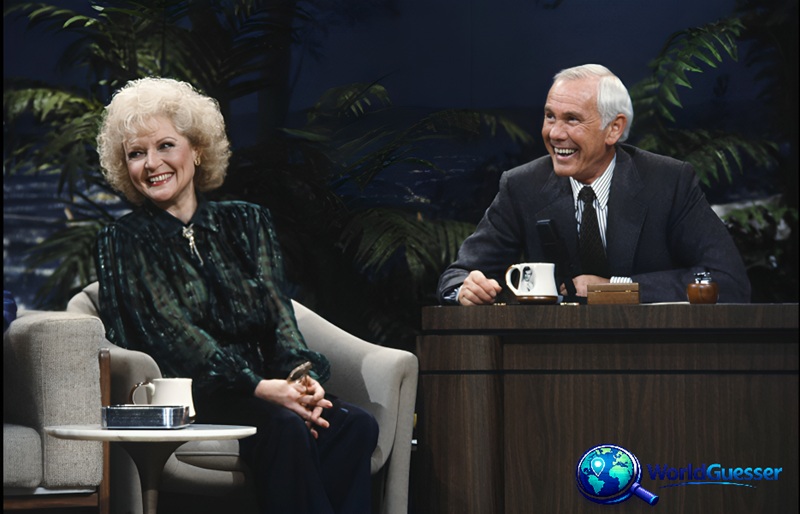
Carson’s first year produced wavering ratings as audiences adjusted to the transition from Paar’s more confrontational style. But by 1963, the show had found its rhythm — and that rhythm would sustain it, through the presidencies of eight American commanders-in-chief, through cultural revolutions in music, politics, and social norms, through thirty years of American history reflected nightly in a single hour of television, for three consecutive decades.
The format Carson established has never been meaningfully improved upon. It began with an opening monologue — topical, political, irreverent — that Carson delivered with a trademark golf swing punctuating the punchlines. This was followed by banter with McMahon and bandleader Doc Severinsen, then sketches and characters, then celebrity interviews. The structure sounds simple. The execution was not.
| The Tonight Show Format | Carson’s Contribution |
|---|---|
| Opening monologue | Established the political/topical comedy benchmark |
| Guest couch | Normalised the conversational celebrity interview format |
| Studio band | Doc Severinsen’s NBC Orchestra became iconic |
| “Here’s Johnny!” | Most recognisable introduction in TV history |
| New York → Burbank move (1972) | Shifted centre of American entertainment industry to West Coast |
| Final show (May 22, 1992) | Drew estimated 50 million viewers — the show’s largest audience |
The move to Burbank, California in 1972 was, in retrospect, one of the most consequential logistical decisions in entertainment industry history. As the New York Times noted in its obituary, Carson’s relocation of The Tonight Show from New York to California was instrumental in shifting the power of the television industry from the East Coast to the West Coast, from Broadway to Hollywood. An entire ecosystem of talent, agents, producers, and studios followed the gravitational centre that The Tonight Show created.
Carnac, Aunt Blabby, and the Characters That Defined an Era
Among the most beloved elements of Carson’s Tonight Show were his recurring comedic characters — the personas he inhabited with such complete commitment that they became cultural touchstones in their own right.
Carnac the Magnificent — an all-knowing Eastern mystic who held sealed envelopes to his turbaned head, divined the answers to questions contained inside, and then opened the envelopes to reveal the question — was the most iconic. The format was perfect for Carson’s comedic sensibility: it allowed for absurdist misdirection, for timing that turned on a single beat, and for self-deprecating recovery when the audience didn’t laugh. Carson’s legendary ability to make jokes about his own failed jokes — to turn a bad punchline into a better one — was never more visible than in a Carnac segment.
Aunt Blabby — a garrulous, shameless elderly woman with opinions on everything — gave Carson a vehicle for social comedy that he could not deliver as himself. Ronald Reagan impressions — particularly potent during the Reagan presidency — demonstrated his political instincts without ever explicitly aligning him with any partisan position.
Carson was scrupulously nonpartisan in public. He believed that taking explicit political positions would compromise his relationship with an audience that included Americans of every political persuasion, and he avoided doing so throughout his career. Privately, he opposed the Vietnam War and capital punishment, favoured racial equality, and held liberal positions on several social issues — but on screen, he played those cards close enough to his chest that even long-term viewers disagreed about where he stood.
The Talent He Launched: A Generation of Comics
Few aspects of Carson’s legacy are more significant than his role in launching the careers of comedians who would go on to define American comedy for the generation that followed him. An appearance on The Tonight Show — a positive one, one where Carson laughed and waved the comedian over to the couch after the set — was the single most powerful career accelerant available to a stand-up comedian in the 1970s and 1980s.
The list of performers whose careers Carson catalysed is staggering: David Letterman, Jay Leno, Jerry Seinfeld, Drew Carey, Ellen DeGeneres, Tim Allen, Roseanne Barr, Garry Shandling, Bill Cosby, George Carlin, and Joan Rivers — who became Carson’s go-to guest host before a public falling-out ended their relationship. He could, with a single approving gesture after a set, turn an unknown club comedian into a national name overnight. And he was genuinely invested in the talent. Those who knew him describe a man who took the discovery of new comedic voices seriously — who watched sets carefully, who gave genuine feedback, and who made the decision to invite someone to the couch an act of real curatorial judgment rather than a production formality.
His relationship with David Letterman was the most significant of these. Carson privately believed that Letterman — not Jay Leno, who ultimately got the Tonight Show chair after Carson’s retirement — was his rightful successor. He sent Letterman joke material during his retirement years, and Letterman’s first broadcast after Carson’s death consisted entirely of jokes that Carson had quietly been sending in — a revelation that produced one of the most moving moments in late-night television history.
The Private Man: Introversion, Two Johnnys, and the Marriages
The public Johnny Carson — relaxed, warm, effortlessly witty, the man who made every guest feel like the most interesting person in the room — was not entirely the private one. Those who knew him well, including his long-time biographers and colleagues, described a man of genuine duality: master connector on screen, cold and aloof at home.
As producer Frederick De Cordova’s account conveys, and as Carson himself acknowledged in a 1979 interview with Mike Wallace on 60 Minutes: “If I pulled out my old high school annual book and read some of the things, people might say, ‘Oh he’s conceited, he’s aloof.’ Actually that was more shy. See, when I’m in front of an audience, it’s a different thing.”
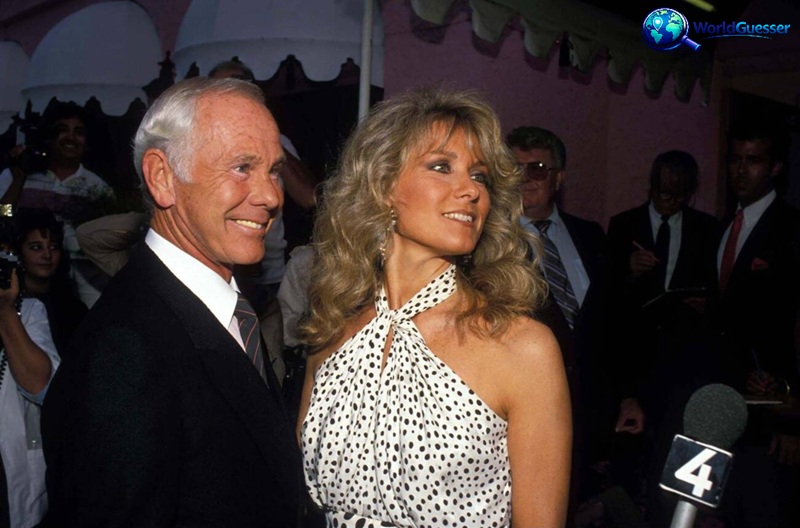
He was married four times. His first marriage, to Jody Morrill Wolcott in 1949, lasted fourteen years and produced his three sons — Christopher, Ricky, and Cory. It ended in divorce. His second marriage, to model Joanne Copeland in 1963, lasted nine years. His third, to Joanna Holland in 1972, ended in one of Hollywood’s most publicised and expensive divorces of the era. His fourth and final marriage, to Alexis Maas in 1987, was by every account the most successful — the longest, the most privately contented, the one that finally gave him the domestic stability his earlier relationships had not provided. He was 61 when he married Alexis. She was 35. They were together for eighteen years, until his death.
His son Ricky died in 1991, killed in a car accident while photographing nature in Cayucos, California. Carson’s on-air tribute to Ricky on The Tonight Show was one of the most emotionally raw moments in the programme’s history — a public expression of private grief from a man who almost never allowed the two to meet.
Retirement, the Desk, and the Quiet Final Years
Carson announced his retirement in 1991 and delivered his final Tonight Show on May 22, 1992. The penultimate episode featured Bette Midler, who sang “One for My Baby (and One More for the Road)” while Carson became unexpectedly tearful — a moment recognised immediately as television history, eventually winning an Emmy. His final episode was a retrospective, no guests, just thirty years of memories. An estimated 50 million Americans watched — the largest audience in the programme’s history.
What followed was one of the most complete retirements in American entertainment history. Carson did not guest-host other programmes. He did not release a memoir. He did not appear at awards ceremonies. He gave almost no interviews. He lived quietly in Malibu with Alexis, pursued his interests in astronomy — he was a close friend of Carl Sagan, who frequently appeared on The Tonight Show — and occasionally sent joke material to Letterman, which Letterman used in his monologue without attribution until after Carson’s death.
He had quadruple bypass surgery in 1999. His health declined in the following years, complicated by the emphysema that decades of heavy smoking had produced. He died peacefully on January 23, 2005, at Cedars-Sinai Medical Centre in Los Angeles, aged 79. No public memorial was held. His estate was valued at approximately $300 million; he donated $156 million to the Johnny Carson Foundation, which continues to fund education and healthcare causes in Nebraska and beyond.
The Legacy: A Standard No One Has Met
The question of whether anyone has truly replaced Johnny Carson as the dominant figure in American late-night television is not seriously contested. The landscape he left behind fractured almost immediately after his departure — Leno and Letterman split the audience; subsequent generations of hosts split it further. The cultural authority that Carson wielded, in which a single late-night programme served as the common viewing ground for tens of millions of Americans of every political and social persuasion, has not been replicated.
Part of this is structural: the fragmentation of the media landscape makes it mathematically impossible for any single programme to command the audience share that Carson regularly delivered. But part of it is simply personal. Carson was, by the consensus judgment of his peers, his successors, and the cultural historians who have studied his career, a singular talent — someone whose specific combination of gifts arrived in the precise moment that could make the fullest use of them, and who devoted himself to that moment with a professionalism and a discipline that produced thirty years of excellence.
Walter Cronkite called him the most durable performer in television history. David Letterman, the person who arguably understood him best, devoted an entire broadcast to his jokes after his death. The Television Academy gave him its Governor’s Award in 1980. The nation’s president gave him its Medal of Freedom in 1992.
He was, simply, Johnny Carson — and that was enough.
Conclusion
Johnny Carson came from Corning, Iowa, grew up in Norfolk, Nebraska, learned magic from a mail-order kit, served his country in the Pacific, studied radio at the University of Nebraska, and spent thirty years as the last face millions of Americans saw before they closed their eyes each night. He launched more careers than any single figure in the history of comedy. He moved an entire industry from New York to California. He delivered political satire to a nation that disagreed about almost everything and made it laugh together anyway. He retired, disappeared, and let his silence speak as eloquently as his wit had for three decades. There has been no one like him before. There has been no one like him since. The desk is still empty. The chair is still waiting.