
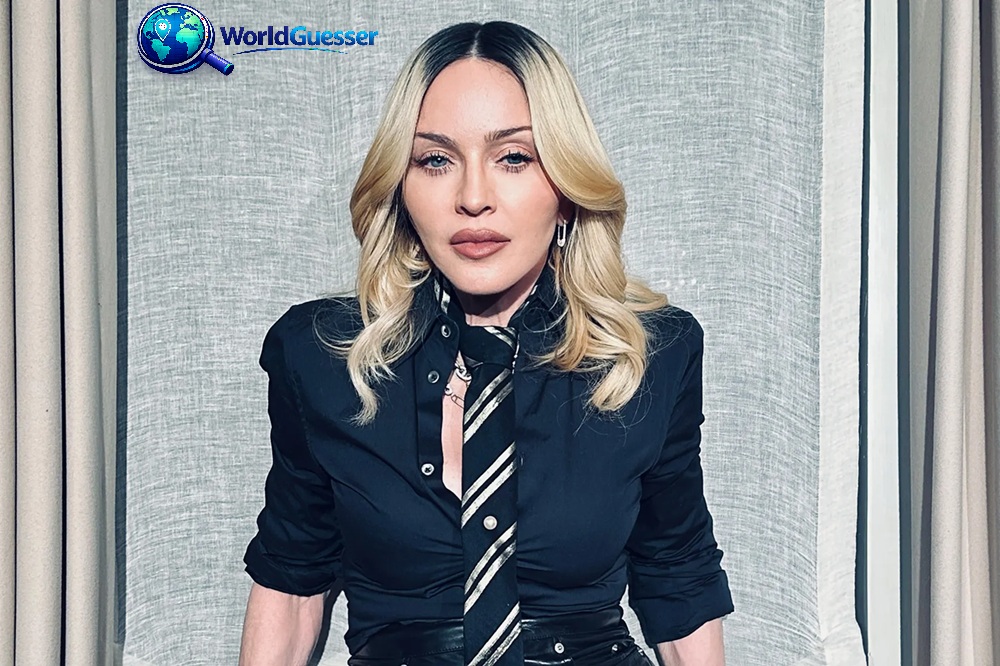
In 1978, a twenty-year-old woman from Bay City, Michigan, dropped out of the University of Michigan — where she had earned a dance scholarship — and took a one-way flight to New York City. She had $35 in her pocket. She knew no one in the city. She had not arranged accommodation. She told the cab driver from JFK to take her to the centre of everything and ended up in Manhattan, which was at the time of her arrival in the specific condition that the late 1970s produced in great cities: dangerous, dirty, financially stressed, and creatively electric.
| Quick Facts | Details |
|---|---|
| Full Name | Madonna Louise Ciccone |
| Date of Birth | August 16, 1958 |
| Birthplace | Bay City, Michigan, USA |
| Raised | Rochester Hills (Pontiac), Michigan |
| Age (2026) | 67 years old |
| Height | 5 ft 4 in (1.63 m) |
| Nationality | American |
| Known As | Queen of Pop; Madge; Material Girl |
| Father | Silvio Anthony “Tony” Ciccone — design engineer (Chrysler/General Dynamics); remarried Joan Gustafson |
| Mother | Madonna Louise Ciccone Fortin — died December 1, 1963 (breast cancer); Madonna was 5 years old |
| Siblings | 7 siblings — Martin, Anthony, Christopher, Melanie, Mario, Jennifer, Paula |
| Education | Dance scholarship — University of Michigan; dropped out 1978; moved to NYC with $35 |
| Early bands | The Breakfast Club; Emmy |
| Record labels | Sire Records (1982–1992); Maverick (1992–2004, co-founded); Warner Records (2021–present) |
| Debut single | “Everybody” (1982) |
| Breakthrough | Like a Virgin (1984) — first album by a female to sell 5 million copies in US |
| Albums | 14 studio albums (1983–2019); 15th confirmed for 2026 |
| Records sold | Over 300 million worldwide — best-selling female recording artist of all time |
| Grammy Awards | 7 Grammy Awards |
| MTV VMAs | 20 MTV Video Music Awards; first female Video Vanguard recipient (1986) |
| Tour revenue | Over $1.6 billion lifetime |
| Celebration Tour | October 2023 – May 2024; $225M+ |
| Acting | Golden Globe Best Actress — Evita (1996) |
| Business | Maverick Records (1992); MG Icon LLC; MDNA Skin; Material Girl fashion line |
| Books | Sex (1992 coffee table book — $1.5M in first 3 days); children’s books including The English Roses (2003) |
| Husband 1 | Sean Penn (m. August 16, 1985; div. September 1989) |
| Husband 2 | Guy Ritchie (m. December 22, 2000; div. November 2008) — settlement ~£50–60M |
| Boyfriend (2026) | Akeem Morris — Jamaican-born; 38 years younger |
| Biological children | Lourdes Maria Ciccone Leon (b. Oct 14, 1996, with Carlos Leon); Rocco Ritchie (b. Aug 11, 2000, with Guy Ritchie) |
| Adopted children | David Banda (b. Sep 2005, adopted 2008); Mercy James (b. Jan 2006, adopted 2009); twins Stella and Estere (b. Aug 24, 2012, adopted Feb 2017) — all from Malawi |
| Philanthropy | Raising Malawi (nonprofit, 2006); Mercy James Institute for Pediatric Surgery (opened 2017) |
| Health scare | Hospitalized June 24, 2023 — bacterial infection; ICU; nearly died |
| Netflix series | Partnered with Netflix and Shawn Levy — May 2025 |
| New album | Confirmed February 2025 — sequel to Confessions on a Dance Floor; produced by Stuart Price; Warner Records |
| Net worth (2026) | $850 million |
Her mother had died of breast cancer when she was five years old. Her stepmother had replaced a woman she had been named after and would never know. Her father had remarried, her childhood had been shaped by the specific loneliness of the eldest daughter in a large Catholic household whose domestic centre had disappeared before she was old enough to understand what had been lost. She had decided, somewhere in the process of that specific formation, that she would not wait for permission to become what she intended to become.
Her name was Madonna Louise Ciccone. Forty-seven years after arriving in New York with $35, she is the best-selling female recording artist of all time — over 300 million records sold, seven Grammy Awards, a Golden Globe, twenty MTV Video Music Awards, lifetime tour revenue exceeding $1.6 billion, an estimated net worth of $850 million, and a confirmed new album coming in 2026. She has six children. Her boyfriend is 38 years younger than her. She nearly died of a bacterial infection in June 2023, recovered, made the Celebration Tour, and is now partnered with Netflix and Shawn Levy for a limited series.
The story of Madonna is the story of what happens when a person decides that the life they are living is not the life they intend to live, and acts on that decision with the specific combination of talent, ambition, and refusal to accept limitation that the entertainment industry’s history has produced in its most enduring figures approximately once per generation.
Bay City, Michigan: The Mother Who Died and the Father Who Remained
Madonna Louise Ciccone was born on August 16, 1958, in Bay City, Michigan — the industrial Saginaw Bay city whose specific character, shaped by the sugar beet industry, the auto parts supply chain, and the tight-knit Catholic working-class community that constituted the social infrastructure of mid-century Michigan, gave her the formation of someone who understood both the value of work and the specific claustrophobia of a community that had decided what was possible before you had the opportunity to discover it yourself.
Her father, Silvio Anthony “Tony” Ciccone, was a design engineer at Chrysler and General Dynamics — a skilled professional whose Italian-American Catholic background and the specific aspirations of a first-generation educated professional shaped the household’s values and expectations. Her mother, Madonna Louise Ciccone Fortin — after whom she was named — died of breast cancer on December 1, 1963. Madonna was five years old. She has described not fully understanding what had happened until she was older; the specific grief of a child too young to process an adult catastrophe is the biographical wound around which much of her subsequent emotional life has been organised.
Tony Ciccone remarried Joan Gustafson — a housekeeper who had been employed by the family — and the household of eight children that the combined family produced gave Madonna the specific social environment of a large Catholic domestic unit whose emotional centre had been permanently altered by the mother’s death and whose new centre she experienced as insufficient. She has described her relationship with Joan with the specific complicated feeling of someone who needed a mother and was given a stepmother, which is not the same thing.
She has said, across multiple interviews over multiple decades, that her mother’s death was the event that made her who she is: “I think not having a mother made me stronger. Since I lacked a female role model, no one was able to instill rules in me. I am not afraid.” The specific logic of that sentence — that the absence of a mother freed her from the rules a mother would have imposed — is the compressed origin story of a career built on the refusal of other people’s limitations.
The family moved from Bay City to Rochester Hills after Tony’s remarriage — the Oakland County suburb whose middle-class aspirations and distance from Bay City’s specific working-class character reflected the specific social trajectory that the Ciccone household’s professional income made possible. She grew up with seven siblings — Martin, Anthony, Christopher, Melanie, Mario, Jennifer, and Paula — in the specific dynamics of a large household whose emotional complexity the mother’s death had permanently complicated.
Rochester Adams High School and the Dance Scholarship
At Rochester Adams High School, Madonna was, by the accounts of those who knew her, genuinely unusual in the specific way of someone who has decided their destiny and is impatient with the institutional processes that stand between the decision and its realisation. She was a cheerleader, a straight-A student, a drama club participant, and already the person in the room whose combination of physical discipline and social nerve set her apart from the expected trajectory of a Catholic girl from Michigan.
The discovery of dance — at a holiday camp at the age of twelve — was, by her own account, the specific revelation that everything else had been preparation for: the physical discipline, the expressiveness, the specific combination of athleticism and art that gave her a language for what she had been feeling without a framework for expressing. She threw herself into it with the total commitment of someone who had found the thing.
She earned a dance scholarship to the University of Michigan — one of the country’s leading universities, whose dance programme represented the most serious institutional training available to her without leaving her home state. She trained there under Christopher Flynn, a ballet instructor who recognised her talent, encouraged her ambition, and introduced her to the gay community in Detroit — the specific social world whose artistic sensibility and outsider identity gave Madonna a community of reference that she has maintained and celebrated across her entire career.
Flynn eventually told her: “You are too big for this place.” She dropped out in 1978, bought a one-way ticket to New York, and arrived with $35.
New York City: Dunkin’ Donuts and the Pearl Lang Dance Company
The New York that Madonna arrived in during 1978 was the specific New York of the city’s fiscal crisis decade — the city that had nearly gone bankrupt in 1975 and had been rebuilt, in the artistic sense, by the specific community of musicians, visual artists, performers, and writers who had colonised its cheap lofts and dangerous neighbourhoods because the rent was what the art required. Downtown Manhattan, the East Village, the Lower East Side, Midtown’s studio system — all of it was available at a price that the current city’s economy has made permanently inaccessible.
She worked her way through the standard survival economy of the young performer: Dunkin’ Donuts, modeling assignments, nude photography sessions whose existence she was not in a position to prevent and whose surfacing years later she was not in a position to suppress. She performed with the Pearl Lang Dance Theater — whose repertoire of modern dance gave her the professional context she needed while the pop career she was actually building developed alongside it.
The specific path from Pearl Lang to Sire Records ran through Paris and back. In 1979, she was recruited by talent scouts for Patrick Hernandez’s tour — the Belgian-French disco singer whose “Born to Be Alive” was a global club hit — and spent time in Paris as a potential backup singer before returning to New York, having concluded that the career trajectory being offered was not the one she intended.
Back in New York, she formed and played with The Breakfast Club and Emmy — early punk and new wave configurations that gave her the guitar and drum training she needed and the specific musical vocabulary of the downtown scene whose energy she was absorbing. She taught herself from her drummer boyfriend Dan Gilroy, whose patience with the process produced the basic musicianship that her subsequent career required.
Sire Records and “Everybody”: The Beginning
The specific account of how Seymour Stein signed Madonna to Sire Records is one of the music industry’s more characterised origin stories: Stein heard her demo tape in 1982 from his hospital bed at Lenox Hill, where he was being treated for a heart condition, and was sufficiently convinced of what he was hearing to have the papers brought to him there. He signed her from his hospital room.
The debut single “Everybody” (1982) was a club record whose specific appeal to the New York dance scene demonstrated that what Madonna had absorbed from the downtown community — the specific rhythmic intelligence of New York club music, the specific vocal delivery of someone who had been performing in rooms rather than studios — translated into recorded form with enough immediacy to generate genuine attention. “Burning Up” (1983) followed, establishing the provocative visual persona that would define the early career.
The debut album Madonna (July 1983) — whose singles “Holiday,” “Borderline,” and “Lucky Star” established her commercial identity — peaked at number eight on the Billboard 200 and introduced the specific visual vocabulary of the early career: crucifixes, lace, fingerless gloves, exposed midriff, the specifically studied casualness of someone who had thought carefully about looking effortless. The look was so influential that “Madonna wannabes” became a documented demographic phenomenon in American teenage culture within eighteen months.
Like a Virgin, the Wedding Dress, and Global Stardom
The performance that announced the arrival of something that the music industry had not previously produced was the 1984 MTV VMAs — where Madonna performed “Like a Virgin” in a wedding dress that she rolled around in on the stage floor, provoking simultaneous outrage, fascination, and the specific cultural moment that transforms a popular act into a phenomenon. The performance was not planned to produce controversy. It was planned to produce exactly what it produced.
Like a Virgin (November 1984) was the first album by a female artist to sell five million copies in the United States — a commercial achievement whose specific historical significance reflects both the quality of the record and the specific cultural force of a persona that had captured something real about the contradictions of female identity in the Reagan decade. The title track’s deliberate provocation and “Material Girl’s” ironic appropriation of Monroe’s “Diamonds Are a Girl’s Best Friend” established the intellectual dimension of what was simultaneously a pop record and a cultural commentary.
The Virgin Tour (1985) — her first concert tour, grossing $5 million — established the live performance infrastructure that would become, across the following four decades, the primary engine of her financial success.
Sean Penn: The Marriage on Her Birthday
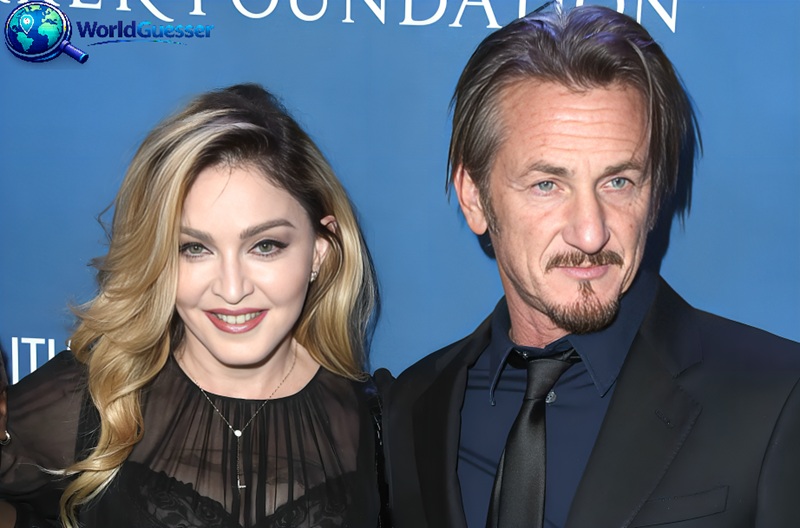
Sean Penn and Madonna The Marriage
Madonna married Sean Penn on August 16, 1985 — her own twenty-seventh birthday — at a Malibu estate whose access points were photographed by helicopter despite the couple’s attempts to prevent it. The specific character of the marriage was established at that moment: two people whose desire for privacy was absolute and whose fame made privacy impossible, attempting to begin a domestic life in the least domestic circumstances imaginable.
The public record of the marriage is largely a record of Penn’s assault charges against photographers and journalists who attempted to document it — the specific volatility of a man who experienced the surveillance as a personal affront and responded with force rather than management. Their one film together, Shanghai Surprise (1986), was a commercial and critical disaster. The marriage generated more press coverage than either party desired and more emotional turbulence than it could sustain.
The musical work of the period was considerably more successful. True Blue (1986) — which reached number one in 28 countries and included “Open Your Heart,” “La Isla Bonita,” and “Live to Tell” — is one of the strongest albums of her career. “Papa Don’t Preach” (1986) provoked the kind of cultural controversy whose specific dynamics — feminist arguments about whether the song endorsed teenage pregnancy, conservative arguments about whether it condoned sexual activity, the Catholic Church’s specific discomfort — demonstrated that Madonna had fully developed the capacity to make music that people could not ignore.
“Like a Prayer” (1989) — released shortly before the divorce — was the most consequential single of the decade’s end: a $5 million Pepsi deal was cancelled after the music video, featuring burning crosses and an interracial romance in a church setting, generated immediate protest from the Catholic Church and the Vatican. The controversy was enormous. The record was a number one hit in many countries. The Vatican’s condemnation was, in retrospect, the most effective promotion the song received.
Madonna and Sean Penn divorced in September 1989. She filed.
Blond Ambition, Truth or Dare, and Maverick Records
The early 1990s produced the chapter of Madonna’s career whose cultural impact most completely exceeds its commercial metrics. The Blond Ambition Tour (1990) — featuring Jean Paul Gaultier’s cone bra, the full staging of “Like a Prayer” with gospel choir, and the performance of “Vogue” that brought ballroom culture into the mainstream consciousness of the international pop audience — is, by the consensus of cultural historians who study popular music, one of the most significant live performance events of the twentieth century.
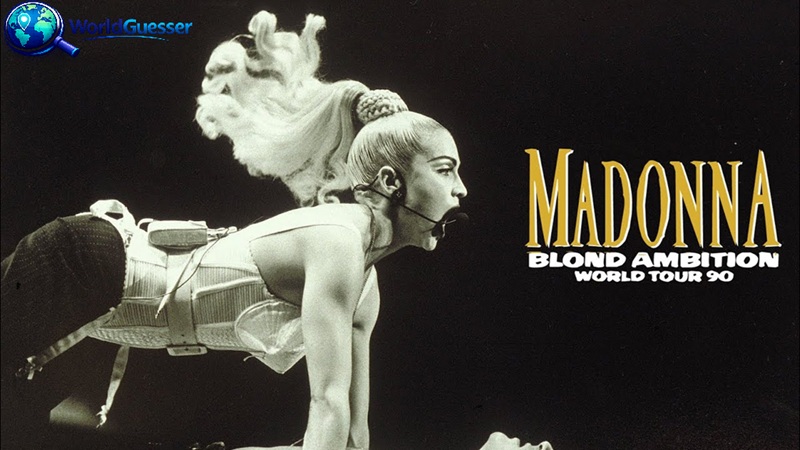
Blond Ambition Tour
“Vogue” (1990) reached number one in thirty countries and performed the specific cultural service of introducing the underground ballroom community of New York — whose art form, developed by LGBTQ+ Black and Latino performers, had been invisible to the mainstream — to a global audience whose subsequent engagement with that culture changed its trajectory.
Madonna: Truth or Dare (1991) — the documentary that followed the Blond Ambition Tour — was the highest-grossing documentary ever made at its time of release. It established the genre of the music-documentary-as-narrative that subsequent artists have followed, and demonstrated Madonna’s specific understanding that controlling your own narrative requires making your own narrative available before someone else makes it for you.
In 1992, she co-founded Maverick Records with Time Warner — negotiating a $60 million advance and a 20% music publishing stake that made her one of the first recording artists to own a meaningful portion of her own commercial infrastructure. The deal was the financial architecture of the business empire that the subsequent three decades would build.
Erotica (1992) and the Sex coffee table book — released simultaneously, the book selling $1.5 million worth of copies in its first three days at $50 per unit — represented the specific challenge of the early 1990s: a deliberate provocation of the limits of what a mainstream female artist could present publicly, whose specific timing in the AIDS crisis gave it a political dimension that the controversy tended to obscure.
Lourdes, Evita, and the Kabbalah Turn
The relationship with Carlos Leon — her personal trainer — produced her first child: Lourdes Maria Ciccone Leon, born on October 14, 1996. The specific experience of becoming a mother at thirty-eight — later than the cultural script she had been departing from her entire career, and on her own terms rather than anyone else’s — produced the tonal shift in her work that Ray of Light (1998) most completely demonstrates.
Before Ray of Light, however, came Evita (1996) — Alan Parker’s film adaptation of the Andrew Lloyd Webber musical, in which Madonna played Eva Perón with the specific combination of vocal discipline and dramatic intensity that the role required and that her detractors had assumed she could not provide. She won the Golden Globe for Best Actress in a Musical or Comedy. She won the Academy Award for Best Original Song for “You Must Love Me.” She earned $1 million and kept the wardrobe. It remains the most complete demonstration of her dramatic capability.
Ray of Light (1998) — produced with William Orbit and reflecting her discovery of Kabbalah — was the album that the music industry had not expected and the critical establishment had not prepared for: an electronic, spiritual, genuinely searching record that won the Grammy Award for Best Album of the Year and demonstrated the specific quality of someone who had completely reinvented their sound rather than simply updated it. “Frozen,” “Ray of Light,” and “The Power of Goodbye” are the songs that the reinvention produced at its best. “Little Star” — written for Lourdes — is the one that most directly documents what becoming a mother had meant.
Guy Ritchie, Rocco, and the 2000s Peak
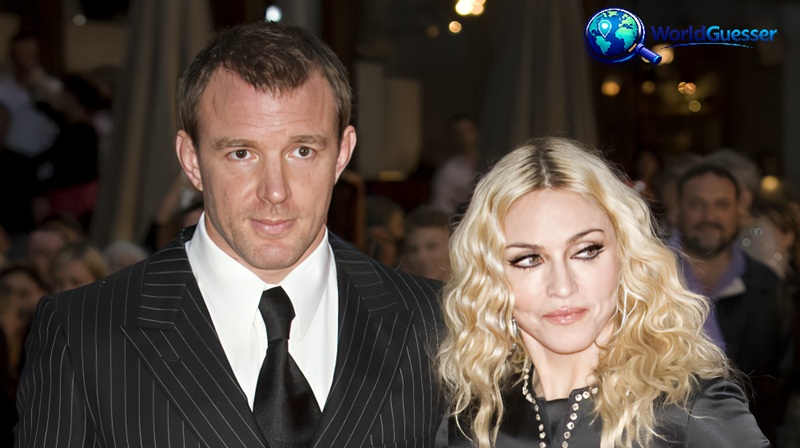
She met Guy Ritchie at a Donatella Versace party in 1998 — the British film director whose specific combination of working-class-made-good energy, directorial ambition, and the particular appeal of someone completely outside the specific world she had been living in for twenty years gave the relationship its initial momentum. Their son Rocco Ritchie was born on August 11, 2000 — baptized at Dornoch Cathedral in Scotland with Gwyneth Paltrow and Sting as godparents — and they married on December 22, 2000, at Skibo Castle.
Music (2000), American Life (2003), and Confessions on a Dance Floor (2005) represent the decade’s artistic arc — from the country-inflected pop of “Don’t Tell Me,” through the politically charged anti-war statements of American Life, to the fully realised disco revival of Confessions, whose “Hung Up” sampled ABBA’s “Gimme! Gimme! Gimme!” with the specific permission that ABBA had never granted to anyone before and have not granted since.
The Confessions on a Dance Floor Tour (2006) grossed $193.7 million — the world record for a female artist at that time. The Sticky & Sweet Tour (2008–09) grossed $411 million — the highest-grossing solo artist tour in history at its completion, exceeding every previous record.
The Malawi adoption story runs through the decade in parallel: David Banda was adopted in 2008, Mercy James in 2009 — both from Malawian orphanages, both the subject of legal challenges from Malawian courts concerned about the adoption procedures, and both ultimately settled in Madonna’s household as permanent members of a family that was expanding in ways that reflected her specific understanding of what wealth and platform obligate.
She and Guy Ritchie divorced in November 2008 — a settlement whose reported value of approximately £50–60 million reflected the specific financial scale of a marriage whose assets had been accumulated primarily through Madonna’s career.
MDNA, Rebel Heart, Madame X, and the Business Empire
The decade between 2010 and 2020 produced three studio albums, the MDNA Tour (2012), the Rebel Heart Tour (2015–2016), and the Madame X Tour (2019–2021), whose combined tour revenue continued to establish Madonna as the highest-grossing female touring artist in history — a distinction she held until Taylor Swift’s Eras Tour surpassed her cumulative records in 2023.
Madame X (2019) — recorded in Lisbon, Portugal, where she had relocated with her younger children for the specific creative freedom that a city outside the Anglo-American music industry provided — reached number one in the United States, making it her ninth US number one album. The intimate theatre tour that supported it was the most deliberately uncommercial concert presentation of her career — small venues, late start times, no support acts — and reflected the specific confidence of someone who had decided that the audience worth having would come on her terms.
The business empire built alongside the music career includes MDNA Skin (luxury skincare, sold internationally), the Material Girl and Truth or Dare fashion lines through MG Icon LLC, the Truth or Dare perfume, and the accumulated real estate portfolio whose properties span New York, Los Angeles, London, and Lisbon. Maverick Records was acquired by Warner Music in 2004, but the accumulated financial benefit of the original deal — the $60 million advance and the publishing stake — had already transformed her financial position permanently.
She adopted twins Stella and Estere Ciccone from Malawi in February 2017 — adding two more daughters to a family that now numbered six children across three continents of origin.
June 2023: The Bacterial Infection That Nearly Killed Her
On June 24, 2023, Madonna was found unresponsive at her New York home and rushed to hospital. Her manager Guy Oseary announced that she had been admitted to the ICU with a severe bacterial infection. She spent several days in intensive care. The Celebration Tour — which had been scheduled to begin in July 2023 — was postponed.
In her first interview in nine years, given after her recovery, Madonna revealed the specific psychological weight of the experience: she had confronted mortality with the specific directness of someone who had spent her entire career controlling the narrative and found herself in a situation that no amount of control could manage. She described considering giving up. She described what brought her back.
The bacterial infection was, in retrospect, the biographical event that clarified the Celebration Tour’s purpose: not merely a commercial exercise or a career retrospective, but the specific statement of someone who had nearly lost the capacity to make it and had chosen, from the specific clarity that proximity to death tends to produce, to make it anyway.
The Celebration Tour and the Brooklyn Finale
The Celebration Tour opened on October 14, 2023, in London — the same date as daughter Lourdes’s birthday, at which Lourdes and several of the other children were present. Daughter Estere joined her mother onstage for the opening night.
The tour ran through May 2024, covering North America, Europe, and South America across more than eighty shows and grossing approximately $225 million. Its career-spanning retrospective structure — drawing from forty years of recorded work — was the most complete available demonstration that the breadth of Madonna’s catalogue exceeded what any single concert’s running time could accommodate.
The Brooklyn finale at Barclays Center in December 2023 was offered as a free concert — more than 50,000 fans attending an outdoor show that functioned simultaneously as a community celebration and a statement about what the tour had been intended for. All six children participated in various dimensions of the tour’s production. They continued their studies on the road.
“If you want to follow your dreams,” Madonna told the audience in Brooklyn, “you have to work hard for them.”
Akeem Morris, New Album, and the 2026 Chapter
Madonna’s current boyfriend, Akeem Morris — Jamaican-born, a Stony Brook University soccer alumnus, 38 years younger than her — was photographed with her in Japan in January 2025, where the appearance of a diamond ring generated engagement speculation that neither party confirmed or denied. Their relationship, which became publicly visible in mid-2024 following the conclusion of the Celebration Tour, reflects the specific trajectory of a person who has consistently refused to allow the entertainment industry’s conventional script about ageing, femininity, and appropriate relationship choices to determine her actual choices.
In February 2025, she confirmed a new studio album — the fifteenth of her career, described as a sequel to Confessions on a Dance Floor (2005), produced by Stuart Price (who produced the original), and scheduled for release through Warner Records in 2026. The decision to return to Stuart Price and the Confessions sound is the specific creative choice of someone who knows where their best work comes from and is willing to revisit it without embarrassment.
In May 2025, she announced a partnership with Netflix and producer Shawn Levy — the director of Deadpool & Wolverine and Stranger Things — for a limited series that will tell the story of her life and career. The project emerged from the stalled biopic development, whose Julia Garner casting had been confirmed but whose budget disagreements had delayed production, and whose reframing as a television series reflects the specific understanding that the full scope of the Madonna biography requires more than two hours to document.
Six Children and the Family She Built
The six children that Madonna has raised — two biological, four adopted from Malawi — represent the most personal dimension of a biography whose public surface has consistently obscured its private depth.
Lourdes “Lola” Leon (b. October 14, 1996), with Carlos Leon, is a model and actress who has fronted campaigns for Savage x Fenty, Marc Jacobs, and Burberry, and who has built a professional identity in fashion and performance that is recognisably her mother’s daughter while being entirely her own. She lives in Bushwick, Brooklyn. She dated Timothée Chalamet in high school.
Rocco Ritchie (b. August 11, 2000), with Guy Ritchie, is a painter working under the name “Rhed” — whose “Talk is Cheap” exhibition in 2024 brought both his parents to the same room in support of his work, demonstrating that whatever the specific cost of the 2016 custody battle whose public dimension was painful for everyone, the relationship between them had been repaired sufficiently to share a gallery opening.
David Banda (b. September 2005, adopted 2008) has built a modelling career including an Off-White debut and sustains his passion for soccer alongside it. Mercy James (b. January 2006, adopted 2009) — after whom the Mercy James Institute for Pediatric Surgery was named when it opened in Malawi in 2017 — celebrated her eighteenth birthday at Madison Square Garden in January 2024. Stella and Estere Ciccone (b. August 24, 2012, adopted February 2017) — twins who are thirteen in 2026 — play football for Tottenham Hotspur’s Under-14 squad and continue their education amid the specific extraordinary circumstances of growing up as Madonna’s daughters.
The Commercial Record: 300 Million Records, $1.6 Billion in Tours
| Milestone | Detail |
|---|---|
| Best-selling female artist | Over 300 million records worldwide — Guinness World Record |
| Grammy Awards | 7 wins |
| MTV VMAs | 20 wins — first female Video Vanguard Award (1986) |
| Golden Globe | Best Actress — Evita (1996) |
| Hot 100 | 36-year run; songs in 5 different decades (with Cher only) |
| Highest-paid female musician | Forbes — 11 times across 4 decades |
| Tour revenue | $1.6 billion+ lifetime |
| Sticky & Sweet Tour | $411M — was highest-grossing solo artist tour in history |
| US certified units | 65.5 million — 4th highest-certified female artist (RIAA) |
Net Worth: The $850 Million Architecture
| Income Source | Estimated Contribution |
|---|---|
| Record sales — 300M+ worldwide | Massive cumulative royalties |
| Concert tours — $1.6B+ lifetime | Primary wealth driver |
| Maverick Records — co-founded 1992; $60M advance + 20% publishing | Foundational wealth event |
| Catalog reissues (2022–present) | Growing royalty stream |
| MDNA Skin luxury skincare | Ongoing product revenue |
| Material Girl + Truth or Dare fashion lines | Fashion income |
| Sex book (1992) — $1.5M first 3 days | Historical revenue |
| Children’s books — The English Roses and others | Royalties |
| Endorsements — Pepsi, BMW, Adidas, Alexander Wang | Historic deal income |
| Art collection — Keith Haring, Basquiat (personally knew both) | Significant asset appreciation |
| Global real estate — New York, LA, London, Lisbon | Substantial asset value |
| Netflix series deal (2025) | Significant upfront payment |
| New album 2026 + Warner Records deal | Advance + royalties |
| Estimated Total Net Worth (2026) | $850 million |
Conclusion
Madonna was born in Bay City, Michigan, on August 16, 1958. Her mother died when she was five. Her father remarried. She earned a dance scholarship to the University of Michigan, dropped out, and moved to New York with $35. She worked at Dunkin’ Donuts and posed for nude photographs to survive. She signed to Sire Records from a hospital room. She performed “Like a Virgin” in a wedding dress at the MTV VMAs and became a global phenomenon. She married Sean Penn on her birthday and divorced him four years later. She built Maverick Records, starred in Evita, won the Golden Globe, found Kabbalah, discovered Stuart Price, adopted four children from Malawi, married and divorced Guy Ritchie, toured the world for $411 million, nearly died of a bacterial infection in her New York home, recovered, made the Celebration Tour, confirmed a new album, partnered with Netflix and the director of Deadpool & Wolverine, and is now 67 years old with a boyfriend 38 years her junior and a new record coming.
She has sold more records than any female artist in history. She has toured for more money than any female artist in history. She was worth $35 when she arrived in New York. She is worth $850 million now.
She is still working.
FAQs
1. How many children does Madonna have? Madonna has six children — two biological and four adopted. Her biological children are Lourdes Maria Ciccone Leon (b. 1996, with Carlos Leon) and Rocco Ritchie (b. 2000, with Guy Ritchie). Her four adopted children — all from Malawi — are David Banda (adopted 2008), Mercy James (adopted 2009), and twins Stella and Estere Ciccone (adopted February 2017).
2. What is Madonna’s net worth in 2026? Madonna’s estimated net worth in 2026 is approximately $850 million, accumulated through record sales, lifetime tour revenue exceeding $1.6 billion, the Maverick Records business venture, fashion and skincare lines, real estate, and her 2025 Netflix deal.
3. Who has Madonna been married to? Madonna has been married twice — to Sean Penn (August 16, 1985 – September 1989) and to Guy Ritchie (December 22, 2000 – November 2008). Her current boyfriend (2026) is Akeem Morris, who is 38 years younger than her.
4. How many Grammy Awards does Madonna have? Madonna has won 7 Grammy Awards across her career, including Best Album of the Year for Ray of Light (1998) and multiple dance and pop category awards.
5. What happened to Madonna in 2023? On June 24, 2023, Madonna was hospitalised with a severe bacterial infection and spent several days in the ICU. The experience was life-threatening. Her Celebration Tour was postponed from its original July 2023 start and eventually launched in October 2023.
6. Is Madonna working on new music in 2026? Yes — Madonna confirmed a new studio album in February 2025. It is described as a sequel to Confessions on a Dance Floor (2005), produced by Stuart Price, and scheduled for release in 2026 through Warner Records. She has described the songwriting process as “medicine for my soul.”