
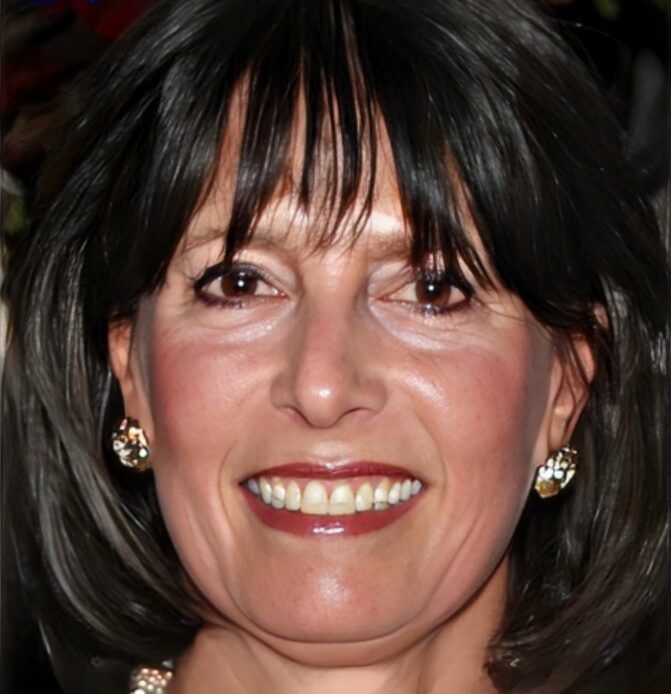
| Quick Facts | Details |
|---|---|
| Full Name | Seryl B. Kushner (née Stadtmauer) |
| Reported Date of Birth | October 22, 1954 (not confirmed in authoritative sources) |
| Birthplace | United States |
| Age (2026) | ~71 years old |
| Religion | Orthodox Jewish |
| Father | Morris Stadtmauer |
| Grandparents | Holocaust survivors — arrived United States 1949 |
| Husband | Charles Kushner (b. May 16, 1954) — real estate developer; founder Kushner Companies |
| Children | Dara Kushner (eldest); Jared Kushner (b. January 10, 1981); Nicole Kushner Meyer; Joshua Kushner |
| Daughters-in-law/Sons-in-law | Ivanka Trump (Jared; converted to Judaism); Joseph Meyer (Nicole); Karlie Kloss (Joshua; converted to Judaism) |
| Grandchildren | Arabella, Joseph, Theodore (Jared/Ivanka); Levi (Joshua/Karlie); others |
| Ivanka resistance | Initially refused to meet Ivanka; Jared briefly split from her 2008; relented after Ivanka converted |
| Philanthropy | Co-founder, Charles and Seryl Kushner Family Foundation |
| Named endowments | Seryl Kushner Dean — NYU College of Arts & Science; Seryl and Charles Kushner Campus — Shaare Zedek Medical Center, Jerusalem ($20M); Seryl and Charles Kushner Maternity Unit — St. Barnabas Medical Center, NJ |
| Trusteeships | NYU Langone Medical Center; Lincoln Center for the Performing Arts |
| Charles’s conviction | 2005 — 18 felonies; 14 months at Federal Prison Camp, Montgomery, Alabama; pardoned December 23, 2020 |
| Charles as Ambassador | Confirmed May 19, 2025 (Senate 51–45); US Ambassador to France and Monaco |
| Current role | Diplomatic spouse — Paris, France |
| Social media | None — completely private |
| Family net worth (est.) | $1.8 billion combined (Forbes 2016 — Charles, Seryl, Jared, Joshua) |
In May 2025, the United States Senate confirmed Charles Kushner as America’s Ambassador to France and Monaco by a vote of 51 to 45. The confirmation was, by the standards of ambassadorial appointments, politically charged — Charles Kushner had in 2005 pleaded guilty to 18 felonies including tax evasion, illegal campaign contributions, and witness tampering, and had served 14 months in a federal prison camp before being pardoned by President Trump on December 23, 2020. The Senate’s narrow confirmation vote reflected those circumstances directly.
Seryl Kushner — Charles’s wife, the mother of Jared Kushner, the daughter of a man whose parents were Holocaust survivors, the woman who in the mid-2000s refused to meet the woman her son was falling in love with because she was not Jewish — packed her things and moved to Paris. She is now the wife of the American Ambassador to France, living in one of the most consequential diplomatic postings the United States maintains, in the city whose Jewish community has roots stretching back centuries and whose relationship with Jewish history carries the specific weight of the Vel’ d’Hiv’ roundup of 1942 and the deportations to Auschwitz that followed it.
The journey from the Orthodox Jewish community of Livingston, New Jersey, to the American Ambassador’s residence in Paris is not a journey that most people’s biographies contain. Seryl Kushner’s biography contains it — alongside the private grief of a husband’s criminal conviction and imprisonment, the public exposure of a son’s White House role, the complicated diplomacy of daughters-in-law who were not born Jewish, and the sustained philanthropic work in Jewish education, healthcare, and culture that represents the most specific expression of her values available in the public record.
The Stadtmauer Family: Survivors and Their Granddaughter
Seryl B. Kushner was born Seryl Stadtmauer — the daughter of Morris Stadtmauer and the grandchild of Holocaust survivors who arrived in the United States in 1949, in the immediate postwar years when the specific horror of European Jewry’s near-annihilation was still unprocessed by the world and by the survivors themselves, and when the Jewish community of New Jersey was receiving and absorbing the families who had survived and were attempting to rebuild.
The specific experience of being raised by parents whose own parents were survivors of the Holocaust is a formation that does not easily lend itself to brief biographical description, but whose effects on the people who inhabit it are documented in sufficient generational and psychological research to be understood in broad terms: a heightened awareness of existential vulnerability, a specific urgency about the maintenance of Jewish identity and continuity, a relationship to the institutions of Jewish community — synagogue, school, charitable organisation — that is not merely social but is understood as an act of survival on behalf of those who did not survive. The importance of marrying within the faith — the insistence on Jewish continuity through Jewish marriage — is, in the context of families whose grandparents survived the systematic attempt to eliminate Jewish people from Europe, not a parochial social preference but a specifically weighted inheritance.
This context is essential to understanding Seryl Kushner’s initial response to Ivanka Trump, and to the broader pattern of her life’s commitments.
She grew up in Livingston, New Jersey — the Essex County suburb whose Jewish community in the 1950s and 1960s was substantial, well-established, and shaped by the specific values of Orthodox observance that the Stadtmauer family maintained. Livingston’s Jewish institutions — synagogues, day schools, charitable organisations — provided the social and spiritual framework of Seryl’s childhood and adolescence, and the values that framework transmitted became the organising principles of her adult life and the standards she applied to the household she built with Charles Kushner.
Marriage to Charles Kushner and the Family They Built
Charles Kushner was born on May 16, 1954 — the same year as Seryl, in the specific New Jersey Jewish community world whose geographic and social parameters were sufficiently bounded that the meeting of two young people from that world was simultaneously inevitable and consequential. Charles’s father, Joseph Kushner, was himself a Holocaust survivor — a man who had arrived in the United States after surviving the war in Europe and had built, through the Newark Kushner Companies real estate operation, the foundation of the family business that Charles would expand into one of the most significant real estate development enterprises in New Jersey and New York.
Their marriage — solemnised in the Orthodox Jewish tradition, in the early 1970s — produced four children whose adult trajectories span the full range of what the Kushner family’s wealth, social position, and specific values made available:
Dara Kushner, the eldest child, has maintained the most complete privacy of the four siblings — the biographical sources that document the Kushner family contain relatively little specific information about Dara’s adult life beyond her membership in the family structure.
Jared Kushner, born January 10, 1981 — the eldest son — followed his father and grandfather into real estate, attended Harvard College, purchased the New York Observer newspaper in 2006, led and expanded the Kushner Companies real estate portfolio, married Ivanka Trump in 2009, served as Senior Advisor to the President during Donald Trump’s first administration (2017–2021), and has remained one of the most consequential figures in the intersection of American real estate, politics, and the Trump political movement.
Nicole Kushner Meyer married Joseph Meyer and has been involved in Kushner Companies business operations, most prominently in the 2017 controversy surrounding a presentation in Beijing in which EB-5 investor visa opportunities connected to Kushner Companies were marketed to Chinese investors — a presentation that Nicole led and that attracted Congressional scrutiny given Jared’s concurrent White House role.
Joshua Kushner — the youngest son — pursued a separate entrepreneurial path from the family real estate business, co-founding Thrive Capital, the venture capital firm that has made significant investments in technology companies, and Oscar Health, the insurance technology company. He married supermodel and entrepreneur Karlie Kloss in 2018.
Seryl Kushner raised these four children in the Orthodox Jewish tradition that her own upbringing had established as the family’s non-negotiable identity framework — maintaining the specific rhythms of Shabbat observance, kosher dietary law, synagogue attendance, and Jewish education that Orthodox practice requires of the households that sustain it. This was not a performance of identity for public consumption. It was the actual structure of the family’s private life, maintained consistently across the decades of Charles’s professional rise and the various public and private pressures that rise produced.
The Ivanka Question: Faith, Resistance, and Resolution
The story of Seryl Kushner’s initial resistance to Ivanka Trump’s relationship with her son Jared is, in the specific context of her biography, one of the most revealing available accounts of how her values operate under pressure.
When Jared began his relationship with Ivanka Trump — the daughter of the real estate developer and entertainment personality whose public profile was, by 2007, built around The Apprentice as much as around his buildings — Seryl Kushner’s response was not enthusiasm. Ivanka was not Jewish. The specific weight that this fact carried in a household whose grandparents’ parents had survived the Holocaust specifically because they were Jewish — and who had lived, in the postwar years, with the knowledge that their survival was exceptional rather than representative — was not a polite social discomfort. It was a deeply held conviction about what Jewish continuity required and what the family’s obligation to that continuity was.
She refused, initially, to meet Ivanka. The refusal was not rudeness — it was a statement of position. Vicky Ward, whose book Kushner Inc. (2019) drew on multiple family and industry sources, reported that Jared and Ivanka briefly separated in 2008 under the pressure of the family resistance — a period whose specific emotional dynamics were navigated between two families whose positions were, in their own terms, entirely coherent.
The resolution came when Ivanka Trump undertook a formal conversion to Judaism — studying under the supervision of Rabbi Haskel Lookstein of Congregation Kehilath Jeshurun in New York City, a conversion process that the Orthodox community accepts as valid under specific conditions and that Ivanka completed prior to her 2009 marriage to Jared. The conversion was serious and sustained rather than perfunctory — Ivanka has described her Jewish practice as genuine rather than nominal, and the observance of Shabbat and Jewish holidays in the Jared/Ivanka household has been documented across the years of their public life.
Seryl’s acceptance of Ivanka following the conversion was complete. The resistance had been to Jared marrying a non-Jewish woman; the resolution came when Ivanka became a Jewish woman. The logic was entirely consistent with the values that had produced the resistance in the first place.
A similar dynamic played out with Joshua Kushner’s relationship with Karlie Kloss — the supermodel and entrepreneur who converted to Judaism prior to their 2018 marriage. Karlie Kloss has described her conversion as a serious personal commitment rather than a procedural accommodation, and the pattern of the two Kushner sons’ marriages — both with women who undertook formal Orthodox-compatible conversions to Judaism — reflects the specific standard that Seryl Kushner’s household maintained.
Charles’s Conviction: The Year the Family Held Together
In 2004, Charles Kushner was under federal investigation — a process that would eventually result in his August 2004 guilty plea to 18 felony counts including tax evasion, making illegal campaign contributions, and — most dramatically — witness tampering, in the form of a scheme to intimidate a federal witness by hiring a prostitute to seduce the witness (his own brother-in-law), filming the encounter, and sending the recording to his sister.
He was sentenced in March 2005 to two years in federal prison. He served 14 months at the Federal Prison Camp in Montgomery, Alabama — a minimum-security facility — before his release.
The impact of this sequence of events on Seryl Kushner and the family is not documented in the public record with the specific emotional detail that would make it fully comprehensible from the outside. What is documented is the fact of her presence throughout: she visited Charles during his incarceration. She managed the family’s public face during the period of his imprisonment. She maintained the household, the children’s lives — Jared was in his mid-twenties and working; the others were at various stages of their adult development — and the philanthropic commitments that she and Charles had built together.
The witness tampering charge — the most morally damaging of the 18 felonies, the one whose specific ugliness (the prostitute, the film, the envelope sent to his sister) could not be reduced to white-collar complexity — was the dimension of the case that the family found hardest to absorb. Jared Kushner has spoken in interviews about the profound difficulty of navigating his father’s criminality while maintaining his own professional and personal integrity. The specific word he has used — “shame” — is the word of a child processing a parent’s failure, and it suggests what Seryl was also processing, in her own private register, during the same years.
Charles Kushner was pardoned by President Donald Trump on December 23, 2020 — a pardon whose political context, given Jared Kushner’s role as Senior Advisor in the Trump White House, generated significant commentary about the specific relationship between familial loyalty and executive clemency.
Philanthropy: The Endowments That Bear Her Name
The most specific and verifiable record of Seryl Kushner’s values and priorities outside her family life is the charitable work she has conducted, alongside Charles, through the Charles and Seryl Kushner Family Foundation — an organisation whose giving has focused consistently on three areas: Jewish education, healthcare, and the arts.
The Seryl and Charles Kushner Campus at Shaare Zedek Medical Center in Jerusalem — a donation of approximately $20 million — represents the family’s most significant single charitable commitment to Israeli healthcare infrastructure. Shaare Zedek is one of Jerusalem’s leading hospitals, whose founding in 1902 by a German Jewish philanthropist and whose subsequent development as a modern medical centre serving all of Jerusalem’s communities gives it a specific symbolic significance in the landscape of Jewish philanthropy.
The Seryl Kushner Dean position at NYU’s College of Arts and Science — the endowed deanship whose name Seryl carries — represents a major commitment to secular academic excellence at one of America’s premier universities, and whose connection to NYU Langone Medical Center (on whose board Seryl serves as a trustee) suggests a coherent philanthropic strategy centred on the intersection of education and healthcare.
The Seryl and Charles Kushner Maternity Unit at St. Barnabas Medical Center in New Jersey — the state in which the family built its real estate business and raised its children — reflects the local philanthropic commitment that often runs alongside the more nationally prominent giving in major family foundations.
Her trusteeships at NYU Langone Medical Center and Lincoln Center for the Performing Arts place her within two of New York’s most significant institutional philanthropic boards — positions that require both the financial commitment and the personal engagement that board membership at that level demands.
Paris: The Ambassador’s Wife
In January 2025, President Trump nominated Charles Kushner as United States Ambassador to France and Monaco — an appointment whose political and familial dimensions generated immediate commentary. On May 19, 2025, the Senate confirmed the nomination by a vote of 51 to 45 — a narrow margin that reflected the specific controversy of the appointment without ultimately blocking it.
Seryl Kushner has moved to Paris as Charles’s diplomatic spouse — the role that ambassadorial marriages create for the non-diplomat partner, whose official functions include the social and representational duties of the ambassador’s household rather than the diplomatic work itself. The American Ambassador’s residence in Paris — the Hôtel de Pontalba on the rue du Faubourg Saint-Honoré — is one of the most historically significant American diplomatic properties in the world, and the social role of its mistress is commensurately prominent.
Paris is, in the specific context of Seryl Kushner’s biography, a city whose Jewish history is among the most complex and most painful in the European Jewish experience. The French Jewish community — the largest in Europe, deeply rooted but repeatedly tested by the specific history of the Vel’ d’Hiv’ roundup, the postwar reckoning, and the contemporary challenges of antisemitism — is a community with which Seryl Kushner, as the granddaughter of Holocaust survivors and the wife of the American Ambassador, has a relationship that extends well beyond the diplomatic social calendar.
Conclusion
Seryl Kushner was born Seryl Stadtmauer, the granddaughter of Holocaust survivors who arrived in America in 1949 and built an Orthodox Jewish family in New Jersey whose values — faith, continuity, education, philanthropy, the specific obligation of Jewish survival — she has maintained across every chapter of her adult life. She married Charles Kushner, raised four children in the Orthodox tradition, refused to meet her son’s girlfriend until that girlfriend converted to Judaism, supported her husband through a federal conviction and 14 months in prison, endowed a hospital campus in Jerusalem, a deanship at NYU, and a maternity unit in New Jersey, and is now living in Paris as the wife of the American Ambassador to France.
She has no social media. She has given no interviews. The public record of her life exists primarily in the names attached to the institutions she has supported and in the family whose formation reflects what she has valued.
That record — the Jerusalem hospital bearing her name, the Jared Kushner who returned from the White House to his family, the daughters-in-law who converted to the faith she insisted upon — is the biography that Seryl Kushner has actually lived. It is considerably more substantial than the absence of her name from most headlines would suggest.